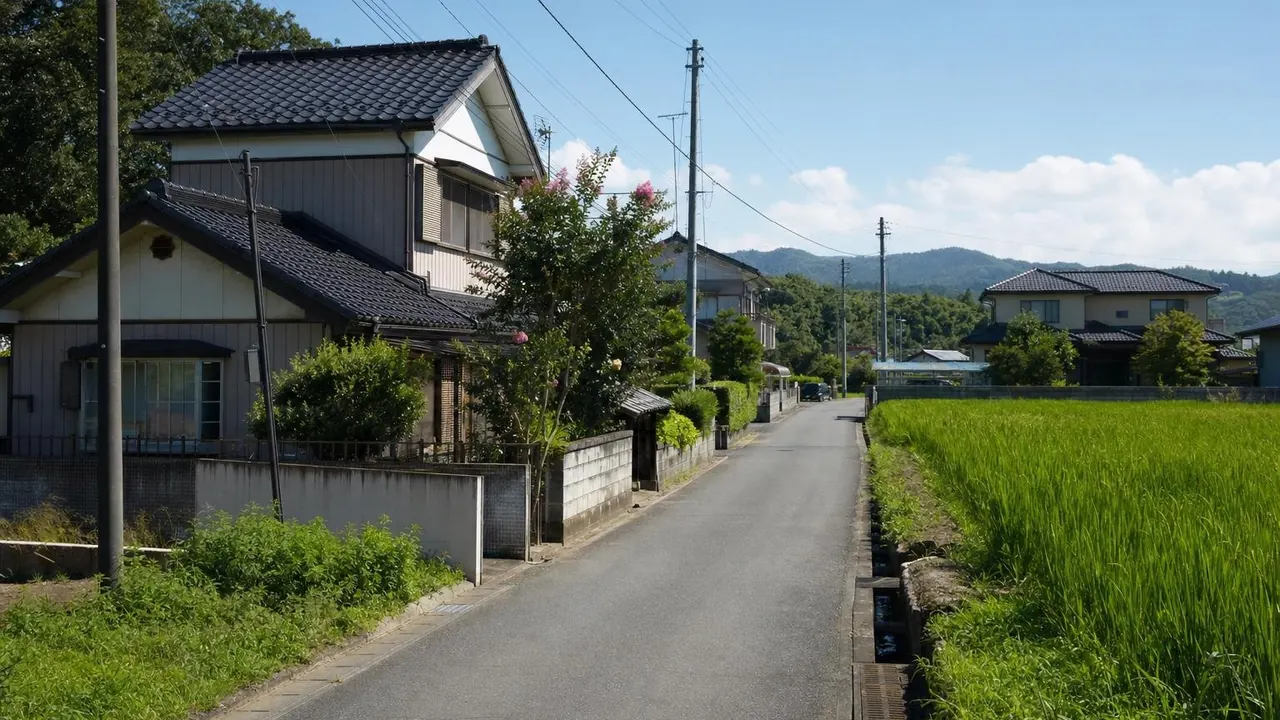
Cheap Houses Near Tokyo: Where Chiba, Saitama, Ibaraki and Gunma Make Sense
Most articles about cheap houses in Japan point you at deep countryside: mountain villages, islands, towns three hours from the nearest shinkansen stop. That is one version of the dream. But there is a quieter middle option that gets far less attention: the outer ring of the Kanto region, where prices collapse surprisingly fast once you leave the commuter core, while Tokyo stays reachable for a monthly errand, a client meeting, or an airport run.
USD equivalents of yen figures are approximate, using ¥154 per US$1 for illustration. Yen amounts in parentheses retain the original figures; actual exchange rates and card charges vary.
This is a tour of that ring: what the money buys, and what each prefecture trades away.
The basic pattern: price follows the train line
Around Tokyo, house prices track two things more than anything else: minutes to a major terminal, and walking distance to a station. Move 60-90 minutes out and step 15 minutes back from the station, and detached houses drop from "Tokyo absurd" to entirely ordinary, often US$32,468 to US$97,403 (¥5-15 million) for something habitable, and below that for houses that need work.
The corollary matters for search strategy: within the same town, a station-front house and one a 20-minute walk away can differ by half. If you drive anyway, that walk is where the value hides.
Chiba: the sleeper for coastal living
Everyone knows west Chiba (Funabashi, Urayasu) as commuter land at commuter prices. The interesting part is the Bōsō Peninsula: Isumi, Katsuura, Kamogawa, Tateyama, and the inland hill towns. Surfing beaches, mild winters, and a steady trickle of Tokyo escapees have built real communities of remote workers and semi-retirees there.
What to expect: older detached houses and farmhouses from roughly US$19,481 to US$51,948 (¥3-8 million), with genuinely cheap akiya below that inland. Katsuura is famous for never having recorded 40°C: the sea keeps summers noticeably softer than inland Kanto. The trade-off is transport: the outer peninsula's train lines are slow and infrequent, so life is car-based, and the Tokyo "commute" is realistically occasional, not daily.
Saitama: closest to Tokyo, priced accordingly
Saitama is the most expensive of the four, because so much of it genuinely commutes. The value pockets are in the west and north: Chichibu and the surrounding mountain towns (Hannō, Ogose, Hidaka) for forested valleys and onsen, and the flat farm belt around Kumagaya and Honjō in the north.
What to expect: in Chichibu's basin, livable older houses commonly sit in the US$25,974 to US$64,935 (¥4-10 million) range, and the Seibu line still connects you to Ikebukuro in about 80-90 minutes. Northern Saitama is hot in summer (Kumagaya regularly tops Japan's temperature charts), but it is honest, flat, practical country with shinkansen access at Honjō-Waseda.
Ibaraki: the price outlier
Ibaraki has, for years, ranked at or near the bottom of prefectural land prices in the Tokyo region despite bordering it. There is no single dramatic reason, just a weaker rail image and sprawling car-first towns. For a buyer, that vagueness is the opportunity.
What to expect: around Tsukuba and Tsuchiura, the Tsukuba Express gives you a modern 45-60 minute line into Akihabara, and prices a couple of stations off the axis fall quickly. Further north and along the coast (Mito, Hitachi, Kashima), US$19,481 to US$45,455 (¥3-7 million) buys real space. Ibaraki is arguably the cheapest "still plausibly Tokyo-connected" prefecture in Japan. The trade-off is aesthetic rather than practical: less postcard, more roadside, though the Tsukuba science-city greenery and the coast both have their fans.
Gunma: mountains, onsen, and the lowest entry prices
Gunma is where Kanto shades into real countryside. Takasaki anchors the prefecture with a shinkansen stop (50 minutes to Tokyo Station), and around it spread onsen towns (Kusatsu, Ikaho, Minakami) plus ski areas and serious mountains.
What to expect: habitable houses from roughly US$12,987 to US$38,961 (¥2-6 million) away from Takasaki's center, and resort-area properties (including cheap older ski condos) below that. Winters are colder, some areas see real snow, and away from the Takasaki-Maebashi axis you are fully car-dependent. If your goal is a mountain base with a bullet-train escape hatch rather than a commute, Gunma is hard to argue with.
The honest trade-offs, all four at once
- Car dependency. Outside station cores, assume one car per adult. Check parking on the lot before anything else.
- Older stock. Much of what is cheap was built before June 1981 or in the 1980s bubble sprawl. Check the seismic standard. Our guide to what 1981 means for buyers explains how.
- Running costs don't shrink with price. A US$25,974 (¥4 million) house still pays fixed asset tax, insurance, and maintenance every year. The numbers are in our annual cost of ownership breakdown.
- Resale liquidity. You are buying in markets where supply exceeds demand. Buy for use, not for appreciation: Japanese homes generally depreciate, and the exceptions cluster near stations.
How to search this ring
Start wide with phrases like house for sale Chiba under US$51,948, Ibaraki detached house cheap, or 中古戸建 群馬 300万円. Then narrow by the constraint that actually rules your life: station walk time if you'll commute, sunlight and land size if you won't. And before shortlisting anything, run it through the same filter you would use anywhere in Japan: the total cost behind the listing price, not the sticker.
The outer Kanto ring is not a compromise version of the akiya dream. For a lot of buyers, especially first-timers who want cheap and connected, it is the version that actually works.
Browse live verified houses: Chiba, Saitama, Ibaraki, Gunma, Tokyo, and the Kanto region page.
Further Reading
- Chiba houses for sale
- Saitama houses for sale
- Ibaraki houses for sale
- Gunma houses for sale
- Tokyo houses for sale
- Houses for sale in Kanto
- MLIT land price publication (地価公示)
- Statistics Bureau of Japan: 2023 Housing and Land Survey
Next practical guide: A 10-Minute Walk to the Station? Check the Whole Commute.