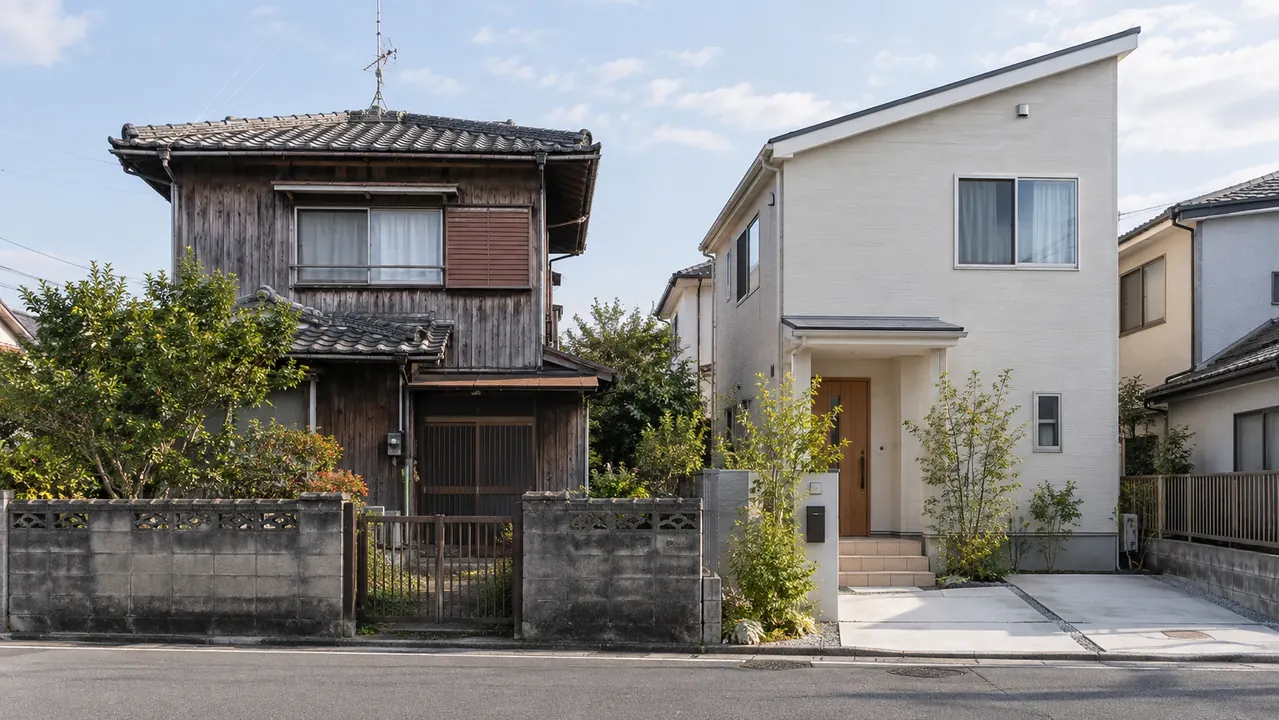
Header image: AI-generated illustration, not a property listing.
Why Japanese Homes Depreciate, and Where That Breaks Down
Newcomers to the Japanese market are routinely shocked: a 25-year-old wooden house often shows a building value of zero, with the entire price attributed to land. The pattern is real, codified in tax law, and reinforced by buyer behavior, but it no longer holds everywhere.
Where the depreciation comes from
The National Tax Agency's useful-life table assigns:
- Wood-frame: 22 years
- Light-gauge steel: 27 years
- Reinforced concrete (RC): 47 years
Banks lend against the building portion only up to this remaining life, which is why a 30-year wooden house is hard to mortgage. Combined with a cultural preference for new builds and a post-war reconstruction-style market, this pushes prices toward "scrap-and-rebuild" economics in most of the country.
Where it stops working
The depreciation curve assumes generic, replaceable houses. Three categories ignore it:
- Central Tokyo wards (Minato, Shibuya, Chuo, Chiyoda): land scarcity dominates and well-built RC towers hold value far past their 47-year line.
- Kyoto kominka and machiya: historical premiums and tourism demand have created a parallel market where age increases value.
- Walkable neighborhoods near major JR stations (Yokohama, Fukuoka, central Osaka), where transit access offsets building age.
What it means for buyers
- For most of Japan: price the land, ignore the building. Renovation is your call.
- For premium urban blocks: structure and condition matter again, and a recently renovated unit can outprice newer construction nearby.
- Don't pay for "remaining building life" outside the major metros. The market will not pay you back when you sell.
The 22/47 rule is a useful default, not a universal one. Knowing where it breaks is half the work of finding undervalued inventory.