Earthquake Standards for Old Japanese Houses: What 1981 Means for Buyers
Almost every cheap house in Japan is cheap partly because of its age, and age in Japan is measured against one date: June 1, 1981. That is when the country introduced the shin-taishin (new seismic) building standard. Houses approved before that date were designed under the older kyu-taishin rules, and lenders, insurers, and buyers all treat them differently.
USD equivalents of yen figures are approximate, using ¥154 per US$1 for illustration. Yen amounts in parentheses retain the original figures; actual exchange rates and card charges vary.
If you are searching houses for sale in Japan in the countryside, most of what you see was built in the 1970s and 1980s. Knowing which side of the line a house sits on is one of the fastest ways to separate a bargain from a project.
Can a pre-1981 house be brought up to current standards?
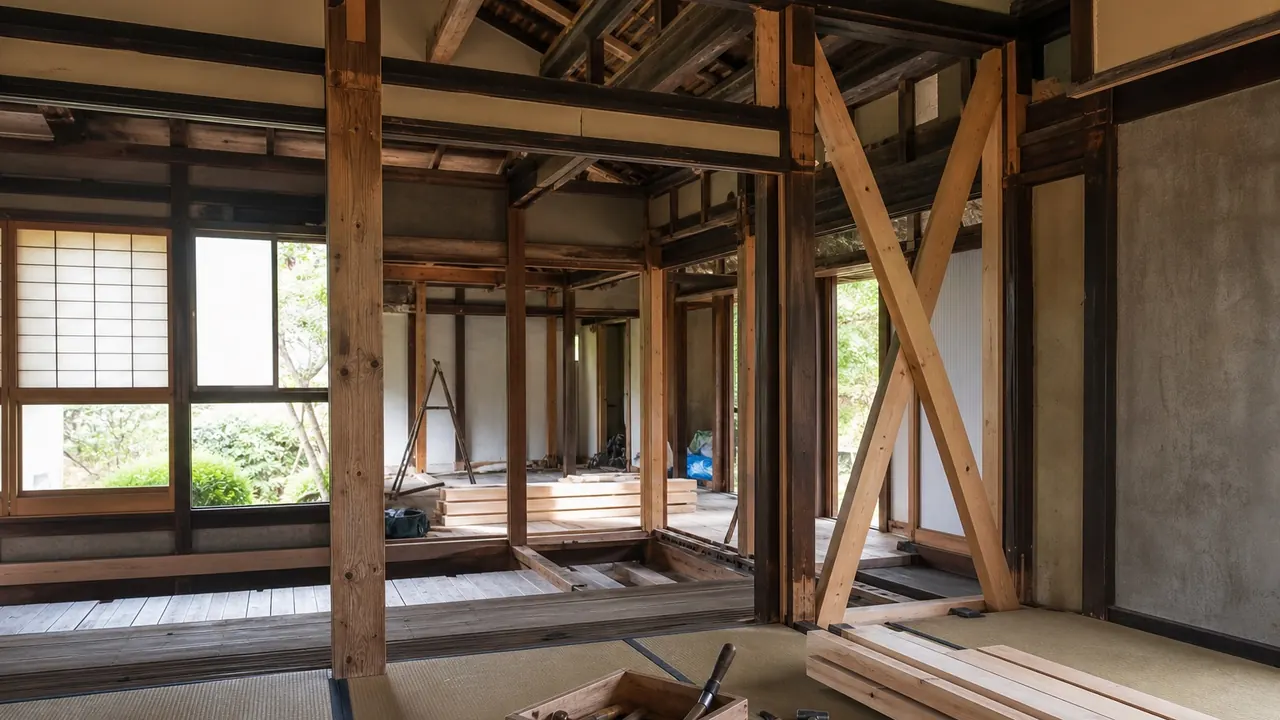
Yes, but price it in before you offer. A pre-1981 wooden house first needs a seismic diagnosis (taishin shindan), typically ¥100,000 to ¥200,000, and often a retrofit, commonly ¥1 million to ¥2.5 million. Many municipalities subsidize the diagnosis and part of the retrofit for houses approved before June 1, 1981. Ask for the approval date first.
A standard pre-purchase inspection will not settle this on its own: it is mainly a visual condition check, and seismic performance is a separate judgment. Our guide to what to ask a home inspector to check shows how to define what an inspection covers before you pay for it.
Should I buy an apartment in a building approved before June 1981?
Only after reading the building's seismic record. The same date rule applies to condominiums: what counts is the building confirmation date, not completion. Ask the management company whether the building has had a seismic diagnosis, what it found, and whether retrofit work is planned and funded, because owners share that cost through the repair reserve.
What Changed in 1981
The 1981 revision required buildings to survive a strong earthquake (roughly shindo 6 upper to 7) without collapsing, not just resist a moderate one. For wooden houses there was a second important update in 2000, which added requirements for foundation specifications, structural connection hardware, and balanced placement of load-bearing walls.
In practice this creates three generations of wooden houses:
- Pre-1981 (kyu-taishin): designed under the old standard, highest structural uncertainty
- 1981 to 2000: new standard, but connections and wall balance were not yet fully specified
- Post-2000: current baseline for wooden construction
Check the Approval Date, Not the Completion Date
The standard that applies is decided by the building confirmation date (kenchiku kakunin), the day the plans were approved. A house completed in early 1982 may still be a kyu-taishin building because it was approved in 1980. Ask for the building confirmation certificate, or have an agent verify the approval date, before assuming a "1982 house" meets the new standard.
Seismic Diagnosis and Retrofit Costs
For pre-1981 houses, the standard next step is a seismic diagnosis (taishin shindan) by an architect or inspection company. Typical costs run around US$649 to US$1,299 (¥100,000 to ¥200,000), and many municipalities subsidize part or all of it for older homes.
If the diagnosis recommends work, a seismic retrofit (taishin hoshu) for a typical wooden house often lands between US$6,494 and US$16,234 (¥1,000,000 and ¥2,500,000), depending on the foundation, roof weight, and wall layout. Municipal subsidy programs frequently cover a meaningful share. Heavy tile roofs, weak first-floor shop fronts, and houses on soft ground push costs up.
That number belongs in your budget the same way renovation does. Our guide to the total cost of a cheap house in Japan shows how purchase price is only the entry ticket.
What This Means for a Purchase Decision
- A pre-1981 house is not automatically a bad buy, but price the diagnosis and retrofit in from the start
- Earthquake insurance is available for old houses, and verified seismic performance can earn discounts
- If you plan to rent the house out or host guests, structural work moves from optional to essential
- A post-2000 house at a slightly higher price is often cheaper than a retrofitted older one
When you view a property, pair this structural check with the practical items in our home viewing checklist.
Search Phrases This Helps With
This article supports searches like 1981 earthquake standard Japan, shin-taishin, kyu-taishin house, old house earthquake safety Japan, and seismic retrofit cost Japan.