Tanabata and Japan's Summer Festival Season: What July Feels Like When You Own a Home Here
We usually write about prices, taxes, and paperwork. This one is about the other reason people buy a house in Japan: the year has a rhythm here, and July is its loudest, warmest chapter. As we write this it is the eve of Tanabata, and across the country bamboo branches are already going up in shop windows and station concourses. Owning a home rather than visiting means you live inside that calendar instead of catching it by accident.
Tanabata, July 7: Wishes on Bamboo
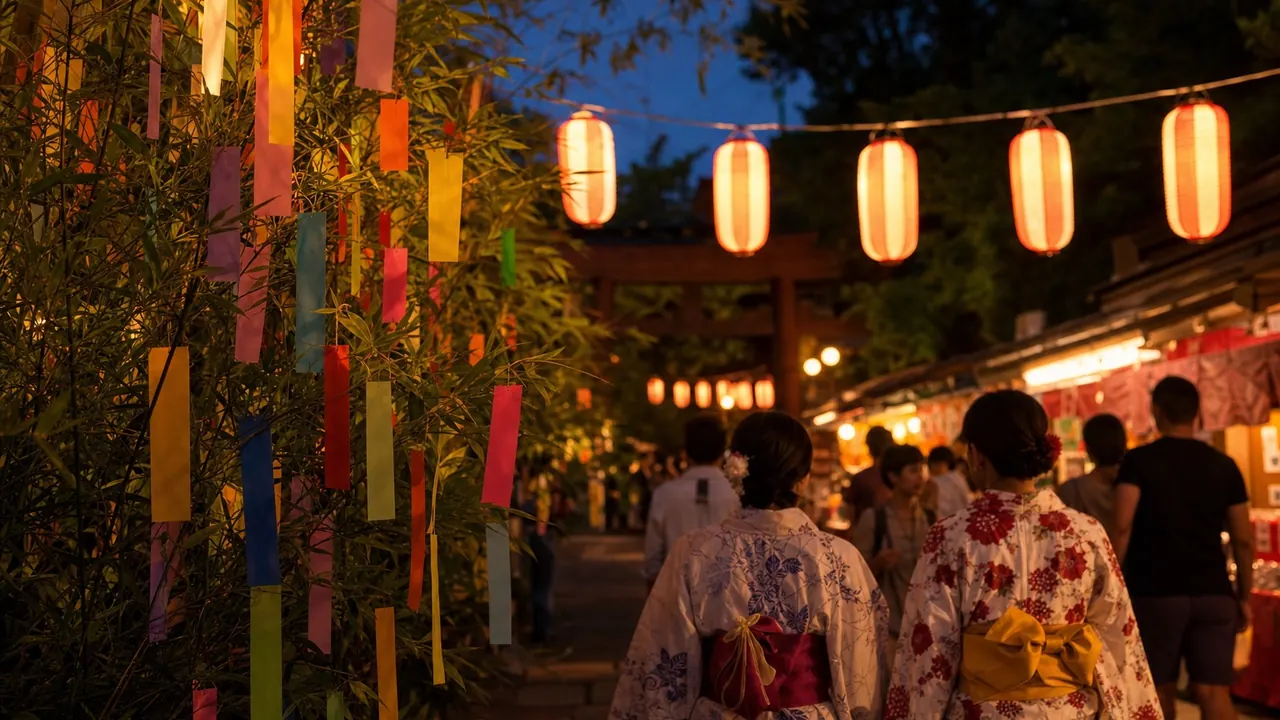
Tanabata, the Star Festival, falls on July 7. It tells the story of two lovers, Orihime (the star Vega) and Hikoboshi (Altair), separated by the Milky Way and allowed to meet just once a year on this night. The custom you will see everywhere is writing a wish on a colorful paper strip, a tanzaku, and tying it to a bamboo branch. Neighborhoods, schools, and shopping streets fill with them.
Some regions keep the older lunar timing and celebrate in August instead. The largest of all is the Sendai Tanabata Matsuri in Tohoku (August 6 to 8), where downtown arcades disappear under giant handmade paper streamers. If your search leans toward cheap houses in the north, this is the festival your town will revolve around.
Kansai Owns the July Calendar
Two of Japan's three great festivals happen in July, and both are in the region we index most closely.
Gion Matsuri (Kyoto) runs the entire month. It began in the 9th century as a purification rite at Yasaka Shrine to end a plague, which makes it over eleven hundred years old. Its signature spectacle is the Yamaboko Junko, processions of towering wooden floats hung with tapestries and pulled through central Kyoto, on July 17 and again on July 24. The three Yoiyama evenings before each parade turn downtown into lantern-lit, stall-lined pedestrian streets.
Tenjin Matsuri (Osaka) is the signature festival of the city we focus on, held on July 24 and 25. It honors Sugawara no Michizane, the deified scholar enshrined at Osaka Tenmangu, and it is more than a thousand years old. On the night of July 25 a land procession in period costume gives way to a river procession of over a hundred boats moving along the Okawa, bonfires burning on the water, and votive fireworks overhead. For anyone looking at a home in central Osaka, especially near the river, this happens close enough to feel.
The Rest of a Japanese Summer
Beyond the headline festivals, July is when the whole country leans into summer:
- Hanabi taikai: evening fireworks displays, from small riverside shows to Tokyo's famous Sumida River fireworks in late July
- Yukata: light cotton kimono worn to festivals by people of every age
- Yatai: rows of food stalls selling takoyaki, yakisoba, kakigori shaved ice, and ramune soda
- Bon odori: circle dances held in local parks as Obon approaches
- Furin: glass wind chimes hung at the window, whose sound is meant to feel cool in the heat
Marine Day (Umi no Hi), a national holiday on the third Monday of July (July 20 in 2026), opens the beach season and creates a long weekend. Worth knowing if you are timing a viewing trip: it is one of the busiest domestic travel windows of the year.
What It Means When the House Is Yours
Festival proximity is a real, and double-edged, feature of a property:
- Upside: a home near a famous matsuri carries genuine cultural cachet and strong short-stay rental demand in peak summer. Riverside Osaka near the Tenjin route, or a machiya in central Kyoto, sits inside the event.
- The honest flip side: those same blocks get road closures, dense crowds, and noise for a few days each summer. Some historic Kyoto float neighborhoods even expect resident participation and dues. A rural or coastal akiya gets none of the congestion, and none of the tourism upside, just the quiet neighborhood matsuri that a household actually joins.
Neither is better. They are different lives, and knowing which one you want is part of choosing where to search.
Search Phrases This Helps With
This article supports searches like Japanese summer festivals, Tanabata July 7, Gion Matsuri Kyoto, Tenjin Matsuri Osaka, and what is matsuri season in Japan.