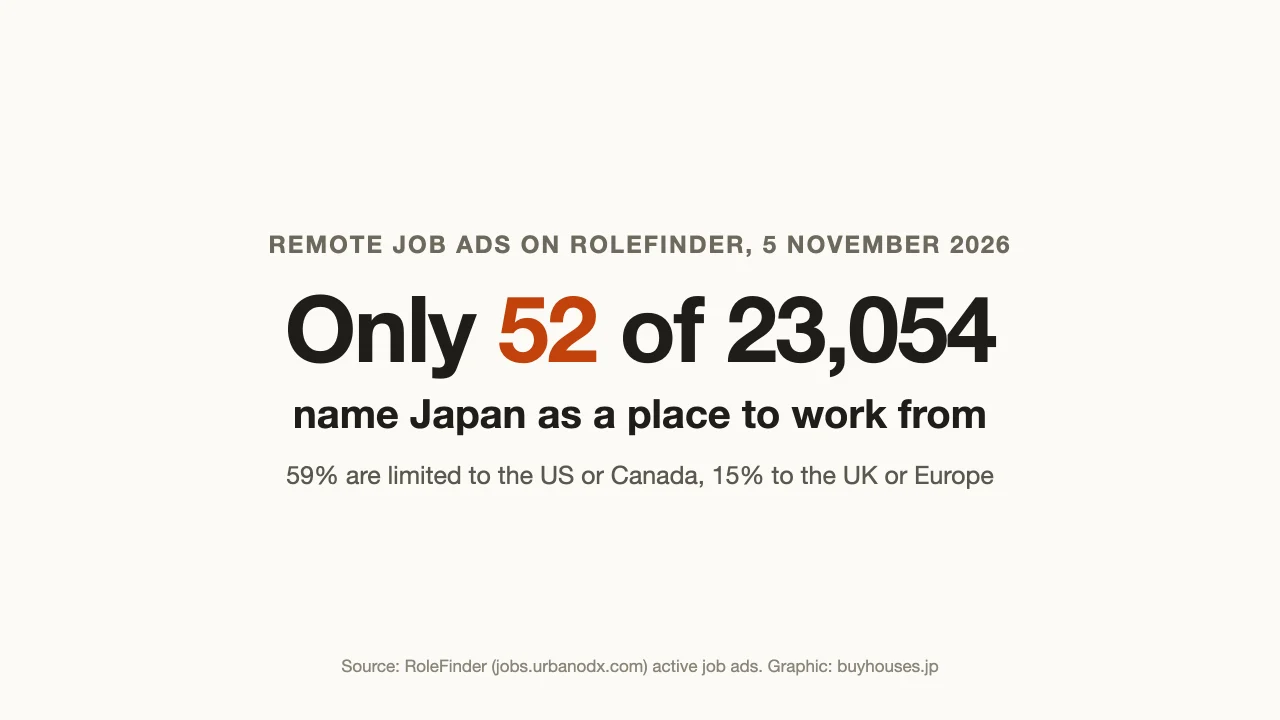
Header image: our own count of remote job ads on RoleFinder, 5 November 2026.
Working Remotely from Japan: Visas, Tax, Time Zones and Housing
Keeping a salary or clients abroad while you live in Japan is possible. Whether it works for you depends on four things, roughly in this order: a residence status that lets you stay, a job that lets you work from Japan, tax and insurance set up correctly, and a home with a connection you have tested. A house comes last, because buying one gives you no right to stay.
The short answer:
- You need a residence status that covers it. The digital nomad status gives you six months. Staying for years needs a family-based or permanent status, or a status tied to running a business or working in Japan. Owning property gives you no status at all.
- Your job has to allow Japan. Of 23,054 remote job ads on RoleFinder on 5 November 2026, only 52 named Japan.
- Tax follows where you sit. Pay for work you do while physically in Japan is Japanese-source income, wherever your employer is and wherever the money lands.
- Check the internet at the exact address, not on a coverage map.
This guide reflects the rules as published on 5 November 2026. Immigration and tax rules change, so confirm your own case with the official pages linked below and, for tax, with an adviser.
Which residence status lets you stay
| Status | How long | Remote work for an employer or clients abroad | What to know |
|---|---|---|---|
| Visa-exempt visit (Temporary Visitor) | Up to 90 days per entry for many nationalities, 15 or 30 days for some | Not expressly allowed or banned | Meant for holidays, family visits and business meetings |
| Digital nomad (Designated Activities) | 6 months, no extension | Yes, it is what the status is for | Income of JPY 10 million a year, private medical insurance, 51 eligible nationalities, no residence card |
| Spouse or child of a Japanese national, permanent resident, spouse of a permanent resident, long-term resident | Years, renewable or permanent | Yes, these statuses carry no limit on activities | Based on family ties or long residence |
| Working holiday | Set by each country's agreement | Only work incidental to a holiday | Usually ages 18 to 30, 33 partner countries and regions |
| Business Manager | Renewable | Only if you run a real business in Japan | Since 16 October 2025: JPY 30 million capital, one full-time employee, upper-intermediate Japanese |
| Work statuses, including Highly Skilled Professional | Renewable | No, they rest on a contract with an organization in Japan | The usual route when a Japanese company hires you |
The digital nomad status
Japan has accepted digital nomads since spring 2024. The Immigration Services Agency sets these conditions:
- What you may do: work remotely for an employer abroad under an employment contract, or sell services or goods to clients abroad as a freelancer. Contracts with Japanese companies or people are not allowed.
- Nationality: your country must be both visa-exempt for short visits and covered by a tax treaty with Japan. The agency's current list has 51 countries and regions, including the United States, the United Kingdom, Canada, Australia, most of the European Union, Korea, Taiwan and Singapore.
- Income: at least JPY 10 million a year of your own income. Freelancers count profit after expenses, and several stable incomes can be combined.
- Insurance: private medical insurance for the whole stay with at least JPY 10 million of medical cover, plus cover for death or repatriation.
- Length: six months, with no extension. According to the agency, once six months have passed after you leave Japan, you can come back on the status again.
- Family: a spouse and children can come on a matching status, but in principle may not work.
The limits matter for daily life. Digital nomads get no residence card, so they cannot register an address, join National Health Insurance or, in practice, open a standard Japanese bank account. The status suits a long stay, not a move.
Working on a tourist entry
The Immigration Control Act bars temporary visitors from activities they are paid for, and no official ruling says whether answering emails for your employer abroad during a holiday falls under that. One Tokyo law firm calls the risk of working remotely on a short stay theoretical and says it is judged case by case; other advisers are stricter. Coming to Japan mainly to work is what the digital nomad status was created for. Repeated long visits that look like living here can lead to questions at the border or a refused entry.
Long-term statuses
Permanent residents, spouses and children of Japanese nationals or permanent residents, and long-term residents have no limits on their activities, so they can work for anyone, anywhere. Work statuses, including Highly Skilled Professional, rest on a contract with an organization in Japan and do not cover working only for a foreign employer.
The Business Manager status is for running a business in Japan. A reform in force since 16 October 2025 raised the capital requirement from JPY 5 million to JPY 30 million and now asks for at least one full-time employee who is Japanese or has a family-based status, upper-intermediate Japanese (JLPT N2 or similar) from you or that employee, a reviewed business plan and an office that is not your home. Existing holders have until 16 October 2028 before the new criteria fully apply.
Most "remote" jobs do not include Japan
Before the visa, check the job. On 5 November 2026 we counted the open job ads on RoleFinder, a job search site run by the same small team as Buy Houses Japan. Of 23,054 open ads tagged remote, only 52 named Japan, and most of those were jobs based in Japan, such as sales and medical roles, for people who already have the right to work here.
To see where the rest let you work from, we read the allowed locations in a random sample of 3,076 remote ads:
| Where the ad says you can work | Share of remote ads |
|---|---|
| United States or Canada only | 59% |
| United Kingdom or Europe only | 15% |
| Another single country or city | 14% |
| No place stated | 5% |
| Latin America | 5% |
| India | 2% |
| Worldwide or anywhere | 0.7% |
| Japan or Asia-Pacific | 0.6% |
"Remote" usually means remote inside one country, because the employer has to run payroll, tax and social insurance where you live. An ad that names no place still has a payroll country behind it. The practical routes are:
- Ask your current employer. An employer that already knows your work is the easiest one to ask. Get the answer in writing: whether you may work from Japan, for how long, and who handles tax.
- Work for clients abroad as a freelancer, so no employer payroll is involved.
- Ask about an employer of record. Some companies hire abroad through a third party that employs you locally. Ask whether it covers Japan.
- Look for roles that are remote within Japan. They exist, mostly in sales, support and engineering, and they need the right to work in Japan.
The time difference decides your day
Japan Standard Time is UTC+9 all year, with no daylight saving time. Your team's location sets your hours. This table assumes both sides work from 9:00 to 18:00:
| Team in | Their working day in Japan time | Shared hours with a 9:00 to 18:00 day in Japan |
|---|---|---|
| London, winter | 18:00 to 03:00 | none |
| London, summer | 17:00 to 02:00 | 1 hour |
| Paris, Berlin or Madrid, winter | 17:00 to 02:00 | 1 hour |
| Paris, Berlin or Madrid, summer | 16:00 to 01:00 | 2 hours |
| New York, all year | 22:00 or 23:00 to 07:00 or 08:00 | none |
| San Francisco, winter | 02:00 to 11:00 | 2 hours |
| San Francisco, summer | 01:00 to 10:00 | 1 hour |
| Singapore | 10:00 to 19:00 | 8 hours |
| Sydney, summer | 07:00 to 16:00 | 7 hours |
A European team means late afternoons and evenings. An American team means nights or very early mornings, and the week shifts too: Friday afternoon in California is Saturday morning in Japan. Teams in Asia and Australia fit a normal Japanese day. Agree on the meeting window with your team before you move, not after.
Tax: where you sit decides
Japan's National Tax Agency treats you as a tax resident if Japan is the base of your life, or after one year of continuous residence. Someone who moves here with no end date can be a resident from the day they arrive.
- Pay for work done in Japan is Japanese-source income. It does not matter that your employer is abroad or that the salary goes to a foreign account.
- The non-permanent resident rule does not shelter a salary. Foreigners resident for five years or less out of the last ten pay Japanese tax on foreign-source income only when it is paid in or sent to Japan. Your salary for work done here is not foreign-source, so this helps only with income such as foreign investments.
- Short stays may be exempt under a tax treaty. If you stay a tax resident of your home country, most treaties exempt your employment income when you spend 183 days or less in Japan in the relevant period, your employer is not based in Japan and the pay is not charged to a Japanese branch. Count every day you are physically here, including arrival and departure days. If a later trip takes you over the limit, the exemption can be lost for the earlier days too.
- You may have to file yourself. An employer with no office in Japan does not withhold Japanese tax, so a resident files and pays through their own return.
- Resident tax comes on top. The town where you are registered on 1 January charges about 10% of the previous year's taxable income. If you own a house in a town where you are not registered, that town charges only a small flat amount.
- Your employer carries a risk too. The longer you work from Japan, the higher the chance that tax authorities treat your work as a permanent establishment of your employer here. That is a common reason employers say no.
Book an adviser who knows both countries before you move, and check the treaty between Japan and your home country.
Health insurance and pension
Residents who stay more than three months and are not covered by an employer's Japanese insurance must join National Health Insurance. Premiums depend on your previous year's income and on the town, and you usually pay 30% of medical costs. A foreign employer with no presence in Japan will not enroll you in employee insurance, so a remote worker usually ends up on National Health Insurance.
Residents aged 20 to 59 must also join the National Pension, at JPY 17,920 a month in the year to March 2027. If you leave Japan, you can claim a lump-sum refund within two years if you paid for at least six months and never became eligible for a pension. Japan has social security agreements with 24 countries, which can matter if your employer sends you on assignment.
Pay both on time. From March 2027 the immigration agency will receive health insurance, pension and local tax payment records for use in visa reviews.
Digital nomads are outside both systems and rely on their private insurance.
Bank account, phone and a place to live
The residence card is the key to everyday contracts in Japan.
- Bank account: banks such as Japan Post Bank require a residence card. Visitors and digital nomads usually rely on an account at home or a multi-currency account abroad.
- Phone: since April 2026, online mobile contracts must check identity by reading the chip in your ID document, such as a residence card. Visitors use prepaid or visitor eSIMs.
- A place to live: landlords and guarantor companies normally screen with a residence card, and a standard lease runs for two years. Furnished monthly apartments are the usual first step. In September 2026 one large landlord started a plan for digital nomads that accepts a passport and visa instead, with rent for the whole stay paid in advance.
Internet: check the house, not the map
Fibre reached 97.13% of Japanese households in March 2025, according to the Ministry of Internal Affairs and Communications, and 5G covered 98.6% of the population in March 2026. A 1 Gbps line is standard, and 10 Gbps plans are spreading. NTT East's 10 Gbps plan costs JPY 6,050 a month plus an internet provider fee.
The gap is in the countryside, which is also where houses are cheapest. A village inside a coverage area does not guarantee a line to a particular house. Our guide to checking rural internet before buying walks through the operator questions and a real work test. Starlink sells residential service in Japan and works as a backup. Check its price for your address on the official site, because published prices vary.
Where a house fits
You can buy a house in Japan as a foreigner without a residence status, but owning one gives you no visa. A few rules have changed recently:
- Report the purchase if you are a non-resident. Since 1 April 2026, a non-resident who buys property in Japan must file a report with the Ministry of Finance through the Bank of Japan within 20 days, even for their own home. Digital nomads and visitors normally count as non-residents for this.
- Declare your nationality at registration. Since 5 October 2026, every new owner, Japanese buyers included, states their nationality when registering. It is not shown on the public register.
- Watch land near defence sites. On 23 October 2026 the cabinet approved a bill that would require government permission to buy land within about 1 km of defence and coast guard sites, whatever the buyer's nationality. It was not yet law on 5 November 2026.
- Expect to pay cash. Most major banks lend mainly to permanent residents. Our mortgage and tax primer covers the options.
A sensible order is status first, then a rented home in the region you like, then a purchase. Digital nomads who come for six months at a time sometimes keep a house as the base they return to. In that case, plan the empty months with our guide to leaving a house empty in Japan, and budget the annual cost of owning a house.
Relocation grants are less open than they look. The national relocation grant pays up to JPY 1 million per household plus up to JPY 1 million per child, and it does cover remote workers who keep their job, but only for people who move out of central Tokyo (the 23 wards) after living or commuting there for at least the last year. A move from abroad does not qualify. Town subsidies for renovating empty houses usually require you to register as a resident and stay for five years or more.
A checklist before you move
- Status: know which residence status you will hold and whether it covers your work.
- Employer or clients: get written permission to work from Japan, with the length of the stay and who handles payroll and tax.
- Hours: agree on a meeting window that works in Japan time.
- Tax: see an adviser in both countries, and count your days if you rely on the 183-day rule.
- Insurance: private cover for a nomad stay, or National Health Insurance and the National Pension as a resident.
- Housing: rent first, and check the internet at the exact address.
- Purchase: buy once the first six steps are settled.
When you are ready to look, browse houses for sale across Japan or start from the prefecture index. For roles you can do from here, see jobs in Japan on RoleFinder.
Sources
- Immigration Services Agency of Japan: digital nomad status, nomad questions and answers, eligible nationalities, temporary visitors, Business Manager reform
- National Tax Agency: residents and non-residents, Japanese-source pay, counting 183 days
- Ministry of Internal Affairs and Communications: resident tax, fibre coverage, 5G coverage
- Japan Pension Service: National Pension enrollment, social security agreements
- Ministry of Finance: real estate reports by non-residents
- Cabinet Office: regional relocation grant
- RoleFinder job ads, counted by us on 5 November 2026: all 23,054 active remote ads for the Japan count, and a random sample of 3,076 of them for the location shares.