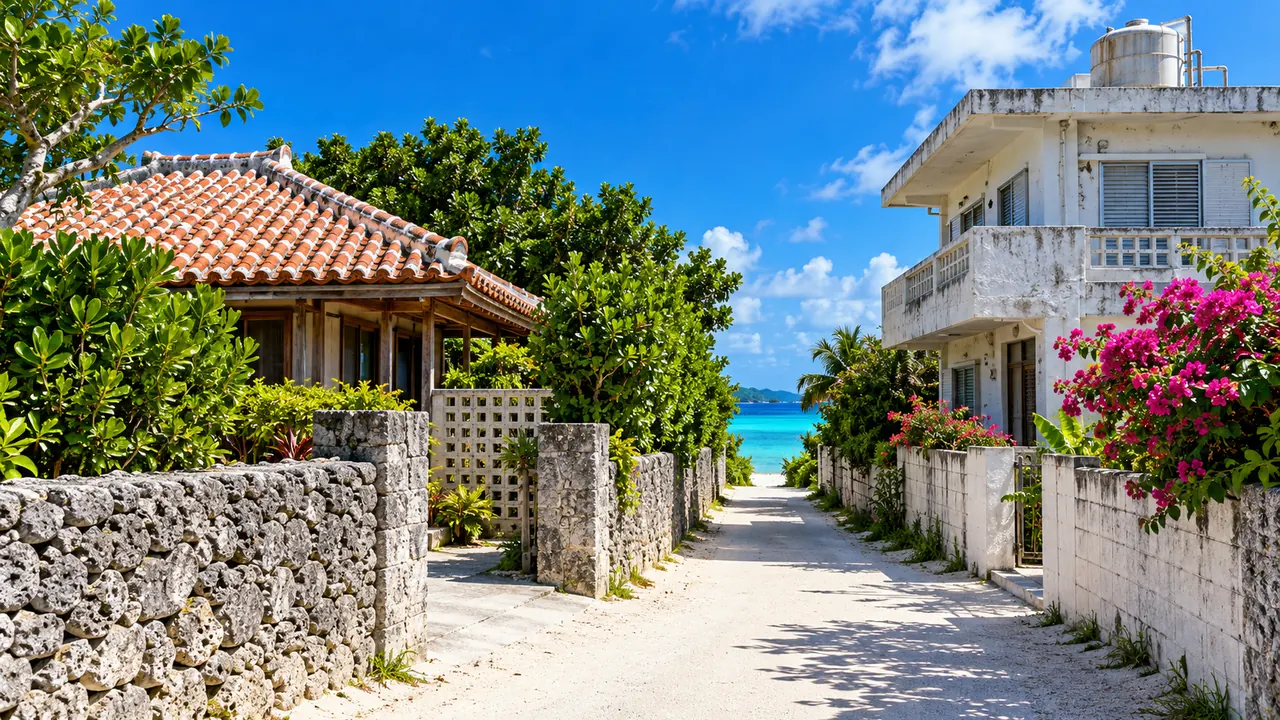
Header image: AI-generated illustration, not a property listing.
Buying a House in Okinawa: A Guide to the Main Island and the Remote Islands
Okinawa breaks the usual rule that Japanese houses outside the big cities are cheap. In our 6 October 2026 snapshot its median asking price was ¥52 million (about US$338,000), second only to Tokyo, and just 3 of 528 houses were listed under ¥5 million (Japan house prices by prefecture). Fewer of its listed houses were built in 1980 or earlier (20% against 29% nationally), and Okinawa builds in concrete: about 94% of occupied homes were reinforced concrete in the 2023 Housing and Land Survey, against about 37% across Japan (our calculation from the Statistics Bureau's counts).
On 15 October 2026 our Okinawa region page listed 477 houses for sale. Our inventory counts the prefecture as a whole, so this guide does not split that number by island. Instead it covers each part of the market in turn: the main island from Naha to the north, then Miyako, Ishigaki and the smaller islands. For the places themselves, start with our overview of Japan's regions.
USD equivalents are approximate, using ¥154 per US$1 for illustration. Yen figures are listed asking prices, not sale prices.
Okinawa at a glance
| Measure | Okinawa | Japan |
|---|---|---|
| Median asking price, 6 Oct 2026 | ¥52 million | ¥17.99 million |
| Houses under ¥5 million, 6 Oct 2026 | 3 of 528 | 3,280 of 24,442 |
| Built 1980 or earlier | 20% | 29% |
| Vacancy rate, 2023 | 9.4% | 13.8% |
| Occupied homes in reinforced concrete, 2023 | about 94% | about 37% |
| Typhoon approaches, normal year | 7.7 | 5.8 (main four islands) |
Okinawa's 9.4% vacancy rate was the second lowest in Japan. Land is the other cost: in MLIT's July 2026 land price survey, Okinawa's average residential land price was ¥79,300 per m² (about US$515), up 5.3% on a year earlier, against a 1.0% national rise (MLIT). Typhoon figures are JMA 1991 to 2020 normals: 7.7 approaches a year for the Okinawa region and 5.8 for Honshu, Hokkaido, Kyushu and Shikoku, where an approach means the storm's centre passes within 300 km of a JMA station (JMA typhoon normals).
The main island: Naha and the south
Naha and the cities around it, Urasoe, Tomigusuku, Itoman and Nanjo, hold most of Okinawa's jobs, hospitals and services, and the monorail serves central Naha and Urasoe. Detached houses here are usually concrete and on small plots. Naha's climate sets the baseline for the island: an annual mean temperature of 23.3°C, 73% mean humidity and 2,161 mm of rain in a normal year (JMA, Naha).
The risk is the building, not the location. Warm, humid, salty air slowly corrodes the steel inside concrete, and older houses near the sea can show cracking and spalling (爆裂) where rust has pushed the concrete apart. Low-lying coastal lots also need the tsunami and storm surge layers checked. See the current Okinawa houses for sale.
The main island: central Okinawa
Central Okinawa, from Ginowan and Chatan through Okinawa city to Uruma and Yomitan, mixes suburbs, beach towns and major US military bases, including Kadena Air Base and Marine Corps Air Station Futenma. It is home to many of the single-storey concrete "foreigner houses" (外人住宅), built decades ago for base personnel and now sold or rented as distinctive homes, alongside ordinary family houses.
Two checks are specific to this area. Aircraft noise varies sharply with distance from Kadena and Futenma air bases, so visit at different times of day before you commit. And ask whether the land comes with the house: if it is leased (借地), the ground rent and renewal terms are part of the price, as our leasehold land guide explains. See the current Okinawa houses for sale.
The main island: the north
Northern Okinawa runs from Nago, the area's service town, along the resort coast of Onna and Motobu to the forested Yanbaru villages of Kunigami, Ogimi and Higashi. Houses range from seaside holiday homes priced for tourism to older village houses that rarely reach the open market.
Distance is the risk. Specialist hospital care, larger building suppliers and most contractors are further south, so repairs take longer to arrange and cost more to deliver. Seaside houses also take the full force of salt and wind. Before you buy, time the drive to Nago and to Naha, and get a contractor to confirm they will service the address. See the current Okinawa houses for sale.
The remote islands: Miyako
Miyakojima is a flat coral island linked by bridges to Irabu, Ikema and Kurima, with its own airport and flights to Naha and the mainland. Tourism has made it one of the more active island markets, and builders and rentals are in demand. Its normal annual mean temperature is 23.8°C and humidity 77% (JMA, Miyakojima).
The risks are typhoons and logistics. The island sits in open ocean on a frequent typhoon track, building materials arrive by sea, and local contractors can be booked months ahead. Get renovation quotes that include materials shipping and confirm the schedule in writing. See the current Okinawa houses for sale.
The remote islands: Ishigaki and Yaeyama
Ishigaki is the hub of the Yaeyama Islands, closer to Taiwan than to Naha, with an airport, a hospital and ferries to Taketomi, Iriomote, Kohama and Hateruma. It is the warmest of the stations in this guide, at an annual mean of 24.5°C (JMA, Ishigakijima). Houses on Ishigaki itself trade more often than on the smaller islands, where a sale can be a rare event.
The risk is everything that depends on a boat. On islands served only by ferry, materials, contractors and specialist care all depend on sailings that typhoons cancel. Ask how long the last renovation took and what it cost to ship materials. See the current Okinawa houses for sale.
The remote islands: Kume, Kerama, Daito and others
Okinawa Prefecture counts 160 islands, 48 of them inhabited: the main island, 9 inhabited islands joined to it by bridge or causeway, and 38 inhabited remote islands (Okinawa Prefecture). Beyond Miyako and Yaeyama, the Kerama Islands lie a short ferry ride from Naha, Kume has its own airport, and the Daito Islands sit far out in the Pacific. Few houses on these islands are listed for sale at any time, and many change hands locally.
For any small island, start with the municipality: it knows whether houses are available, whether there is an akiya bank, and how water, waste and building work are handled. See the current Okinawa houses for sale, and expect that the right house may not be listed yet.
What a concrete house changes for an owner
Concrete is the island's answer to typhoons and termites, and Okinawa's listed houses were relatively new (median build year 1998) and large (median floor area 123 m²) in our October snapshot. Neither makes a house maintenance-free. The work shifts from timber to the shell: renewing the roof waterproofing, repainting the walls, sealing cracks before water reaches the steel, and repairing spalled concrete where it has. Inside, a sealed concrete house in a humid climate needs ventilation and dehumidifying to keep mould away, and air conditioning runs for much of the year.
When you compare an Okinawa house with a cheaper wooden one on the mainland, compare the maintenance cycles as well as the price. A well-kept concrete house with recent waterproofing can be a better buy than a newer one that has been left to the salt.
Okinawa buyer checklist
- Inspect the concrete. Ask the inspector for cracks, rust stains and spalling on walls, balconies and eaves, and for the cover over exposed steel. Repairs to salt-damaged concrete are specialist work.
- Date the roof waterproofing. Most concrete houses have a flat roof. Ask when the waterproof membrane (屋上防水) was last renewed and look for stains on the ceilings below.
- Check typhoon fittings. Shutters, window glass, the rooftop water tank's anchoring, and the outdoor air-conditioning units all take the brunt of storms and salt.
- Look for termites. Wooden houses and wooden parts of concrete houses need a termite (シロアリ) inspection and the treatment history.
- Confirm who owns the land. Ask whether the plot is freehold or leased, and read the leasehold land guide before you compare prices.
- Map the hazards. Coastal lots need the tsunami and storm surge layers on the GSI hazard map portal; see the address-level hazard check.
- Price the island. On remote islands, get quotes that include shipping and contractor travel, and plan who checks the house after each typhoon if you will be away; start with an empty-house management plan.
- Read the support rules. Okinawa Prefecture's own akiya page links national listing sites and a few municipal akiya banks (Okinawa Prefecture). Miyakojima plans a renovation grant of up to two thirds, capped at ¥5 million (about US$32,000), for young or child-rearing couples, but one spouse needs a cumulative three years on the city's resident register, so a newcomer does not qualify yet (Miyakojima City).
How we sourced these figures
House counts were read from our public inventory on 15 October 2026 and change daily. Prices, ages and the under-¥5 million count are our 6 October 2026 snapshot. Vacancy and structure figures are the final results of the Statistics Bureau of Japan's 2023 Housing and Land Survey; the concrete shares are our calculation from its counts of occupied dwellings. Climate and typhoon figures are Japan Meteorological Agency 1991 to 2020 normals.
Ready to compare real houses? Open the Okinawa region page, or compare with houses for sale across Japan.