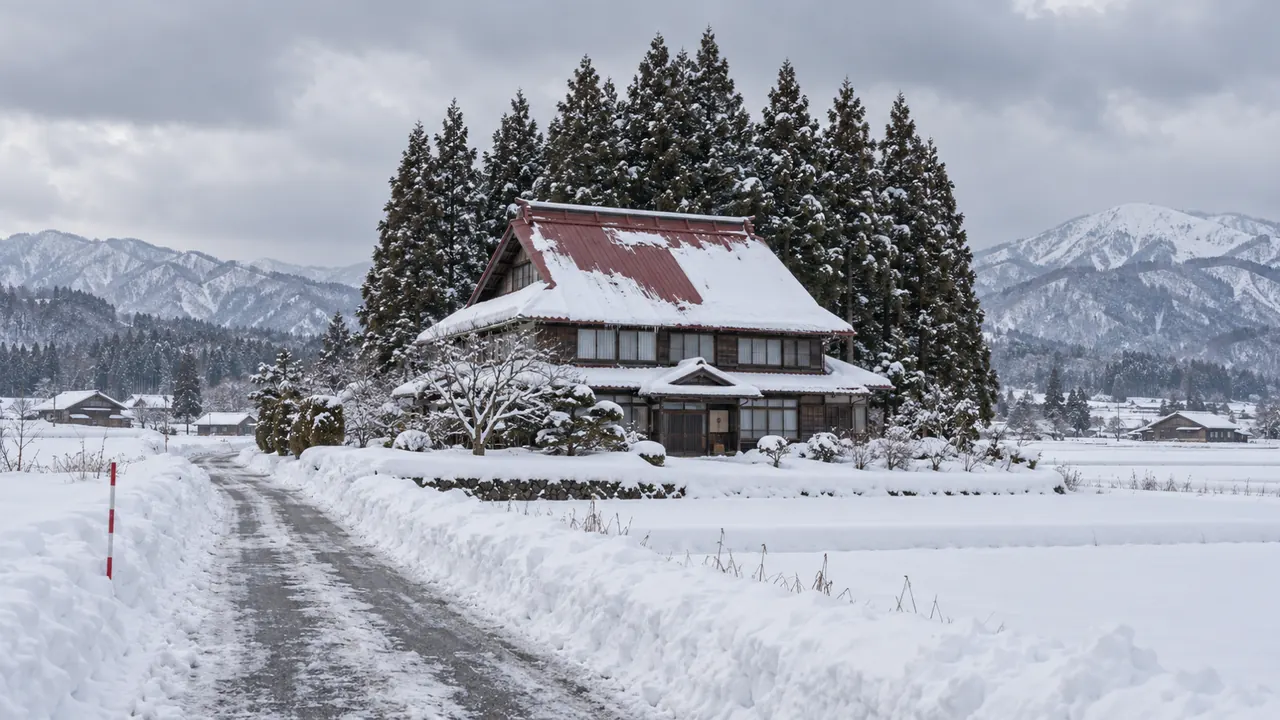
Header image: AI-generated illustration, not a property listing.
Buying a House in Tohoku: A Prefecture-by-Prefecture Guide for Foreign Buyers
Aomori city gets 567 cm of snowfall in a normal year. Sendai, on the Pacific side of the same region, gets 59 cm (JMA climate normals, 1991 to 2020). That gap explains more about a Tohoku house than its listing photos. Asking prices in five of the six prefectures sit below the national median, but the address decides whether you are also paying for roof snow clearing, a kerosene tank and winter tyres, or living much as you would in any mid-sized Japanese city.
On 15 October 2026 our Tohoku region page listed 1,943 houses for sale that passed our availability checks. This guide takes the six prefectures one at a time: the kind of house and life each offers, its main practical risk, and where to see the current houses. For the cultural side of each prefecture, start with our overview of Japan's regions.
USD equivalents are approximate, using ¥154 per US$1 for illustration. Yen figures are listed asking prices, not sale prices.
Tohoku at a glance
| Prefecture | Houses for sale, 15 Oct 2026 | Median asking price, 6 Oct 2026 | Built 1980 or earlier | Vacancy rate, 2023 | Snowfall at the capital, normal year |
|---|---|---|---|---|---|
| Aomori | 369 | ¥15.3 million | 25% | 16.7% | 567 cm (Aomori) |
| Iwate | 322 | ¥14.8 million | 28% | 17.3% | 209 cm (Morioka) |
| Miyagi | 293 | ¥19.8 million | 20% | 12.4% | 59 cm (Sendai) |
| Akita | 312 | ¥12.0 million | 29% | 15.8% | 273 cm (Akita) |
| Yamagata | 320 | ¥13.8 million | 32% | 13.5% | 285 cm (Yamagata) |
| Fukushima | 327 | ¥14.8 million | 34% | 15.2% | 122 cm (Fukushima) |
House counts are the live inventory on 15 October 2026. Medians and building ages come from our 6 October 2026 snapshot of 24,442 houses, explained in Japan house prices by prefecture; the national median in that snapshot was ¥17.99 million (about US$117,000). Residential land is cheap by national standards: in MLIT's July 2026 land price survey the prefectural average ran from ¥13,600 per m² (about US$88) in Akita to ¥55,700 (about US$362) in Miyagi (MLIT). Vacancy rates are from the 2023 Housing and Land Survey and snowfall from the JMA normals linked in each section.
Aomori: the snowiest prefectural capital in Japan
Aomori has the most houses in our Tohoku inventory, and they split three ways: Aomori city and the Tsugaru plain around Hirosaki, with its castle town and apple orchards; the Shimokita peninsula; and the Nanbu side around Hachinohe on the Pacific. The stock is younger than in most of the region, with 25% built in 1980 or earlier. The median asking price was ¥15.3 million (about US$99,000).
The main risk is snow, and it changes sharply across the prefecture. Aomori city's normal annual snowfall of 567 cm, with a normal winter maximum depth of 101 cm, is more than any other prefectural capital, including Sapporo at 479 cm (JMA, Sapporo). Hachinohe, on the Pacific side, gets 134 cm and 27 cm (JMA, Hachinohe). The whole prefecture is a designated heavy snowfall area (豪雪地帯), and Aomori city falls in the stricter special category (特別豪雪地帯) (MLIT). Ask how the roof sheds or holds snow, where it lands, and what the last owner paid each winter to clear it.
See the current Aomori houses for sale.
Iwate: inland cold and a rebuilt coast
Iwate is a large, thinly settled prefecture. Most services and jobs sit along the inland corridor from Morioka through Hanamaki and Kitakami, which follows the Tohoku Shinkansen. The Sanriku coast, from Miyako south to Rikuzentakata, was rebuilt after the 2011 tsunami, and many homes now stand on raised or relocated ground. The median asking price was ¥14.8 million (about US$96,000), with 28% of houses built in 1980 or earlier.
Inland, the cost is cold: Morioka's normal annual snowfall is 209 cm (JMA, Morioka), and long drives between towns make a reliable winter car part of the house. On the coast, check the exact lot on the tsunami layer of the hazard map and ask the municipality whether it lies in a disaster risk zone (災害危険区域), where some coastal towns restrict new homes on low ground.
See the current Iwate houses for sale.
Miyagi: Sendai and its commuter belt
Miyagi is the most urban prefecture in Tohoku. Sendai is the region's largest city, and its suburbs in Natori, Tagajo, Rifu and Tomiya hold most of the detached houses buyers ask about. It has the highest median in Tohoku, ¥19.8 million (about US$129,000), and the youngest stock: 20% built in 1980 or earlier. Snow is a minor factor in Sendai, at 59 cm of snowfall and a normal maximum depth of 16 cm.
The risk here is ground, not weather. The coast was flooded in 2011, and some hillside housing estates around Sendai were built on large areas of fill. Check the lot on the GSI hazard map portal, including its large-scale fill (大規模盛土造成地) layer, and read the seismic history of any house before you rely on its age.
See the current Miyagi houses for sale.
Akita: the lowest median in Tohoku
Akita had the lowest median asking price in the region, ¥12.0 million (about US$78,000), and 53 of the 263 Akita houses in our 6 October snapshot were listed under ¥5 million. The stock ranges from suburbs of Akita city to farmhouses in the rice country around Yokote and older houses in Kakunodate, Odate and Noshiro. Life is quiet and car-based; Akita city and the Akita Shinkansen are the practical anchors. Akita's 2023 vacancy rate was 15.8%, and 10.0% of all its dwellings stood empty for reasons other than rental, sale or second-home use, the eighth highest share in Japan: the kind of long-term empty house that municipal akiya banks try to fill.
Snow and labour are the risks. Akita city's normal annual snowfall is 273 cm (JMA, Akita), and inland valleys get more. In small towns the same few contractors handle roofs, plumbing and snow clearing, so get renovation quotes and a winter maintenance offer before you commit, not after.
See the current Akita houses for sale.
Yamagata: two snowy basins and the Shonai coast
Yamagata divides into inland basins (Yamagata city, Yonezawa and the Mogami area around Shinjo) and the Shonai plain on the Sea of Japan, with Tsuruoka and Sakata. The median asking price was ¥13.8 million (about US$90,000), and Yamagata had the most houses under ¥5 million in Tohoku in our snapshot: 59 of 267. A third of the stock (32%) was built in 1980 or earlier.
Snow depends on the basin. Yamagata city's normal annual snowfall is 285 cm, but Shinjo's is 637 cm, with a normal winter maximum depth of 128 cm (JMA, Shinjo), more than Aomori city. Coastal Sakata gets 211 cm but strong winter winds. Every municipality in Yamagata is a designated heavy snowfall area, and 26 of its 35 are wholly or partly special heavy snowfall areas, the most of the six prefectures. Treat two houses in the same prefecture as different climates until you have checked the town.
See the current Yamagata houses for sale.
Fukushima: three regions in one prefecture
Fukushima is three markets. Aizu in the west is mountainous and snowy, around Aizuwakamatsu. Nakadori, the central corridor through Fukushima city, Koriyama and Shirakawa, follows the Tohoku Shinkansen and is the closest part of Tohoku to Tokyo. Hamadori is the Pacific coast, from Iwaki north to Soma. The median asking price was ¥14.8 million (about US$96,000), and Fukushima had the oldest stock in Tohoku, with 34% built in 1980 or earlier.
Each part has its own check. Aizuwakamatsu's normal annual snowfall is 328 cm against 122 cm in Fukushima city (JMA, Wakamatsu). On the coast, Fukushima Prefecture states that evacuation orders from the 2011 nuclear accident have been lifted everywhere except the difficult-to-return zones (帰還困難区域) (Fukushima Prefecture). Confirm the zone status of the exact address with the municipality, along with what services have reopened nearby.
See the current Fukushima houses for sale.
Tohoku buyer checklist
- See the house in winter. A January or February viewing, in person or by video with a written brief, shows where snow piles up, how the road is cleared and whether the entrance stays usable.
- Name the roof type. Ask whether the roof sheds snow onto the lot, holds it, or melts it with a heated system, and get last winter's clearing or running costs in writing.
- Find where public snow clearing stops. The municipality clears its roads; the driveway and the stretch to your door are yours. Ask for the municipal snow-clearing route and who you can hire for the rest. Aomori city's latest scheme helps some elderly and low-income households pay for roof clearing but excludes vacant houses (Aomori City), so an absent owner pays the full cost.
- Test water and heat. Look for drain-down valves (水抜き) on the plumbing, any history of frozen pipes, the heating system and fuel tank, and the window glazing. An inspection brief should cover rot at the base of walls where snow sits.
- Plan the empty months. If you will not live there all year, write the empty-house management plan before you buy, including who checks the house after heavy snow.
- Check the ground, not just the building. Coastal lots need the tsunami layer and the municipality's disaster risk zones; hillside estates need the fill map; every lot needs the address-level hazard check.
- Check the 1981 line. Between 20% (Miyagi) and 34% (Fukushima) of listed houses were built in 1980 or earlier; read what the 1981 standard means before you shortlist them.
- Read the support rules closely. Help is mostly municipal and tied to moving in. Akita Prefecture's FY2026 programme pays 3/10 of renovation costs, up to ¥600,000, or ¥900,000 with children (about US$3,900 or US$5,800), for households moving in from outside Akita who bought a used house and hire an Akita contractor; foreign nationals qualify only with permanent residence or one of a few family-based or long-term residence statuses (Akita Prefecture). Prefecture portals list each town's akiya bank, for example Akita, Yamagata and Fukushima; our subsidies guide explains how to check a programme.
How we sourced these figures
House counts were read from our public inventory on 15 October 2026 and change daily. Medians and building ages are our 6 October 2026 snapshot. Snowfall figures are Japan Meteorological Agency normals for 1991 to 2020 at the named station. Vacancy rates are from the Statistics Bureau of Japan's 2023 Housing and Land Survey. Hazard checks point to the GSI and municipal maps, because conditions vary lot by lot.
When you are ready to compare real houses, open the Tohoku region page, or widen the search to houses under ¥10 million across Japan.