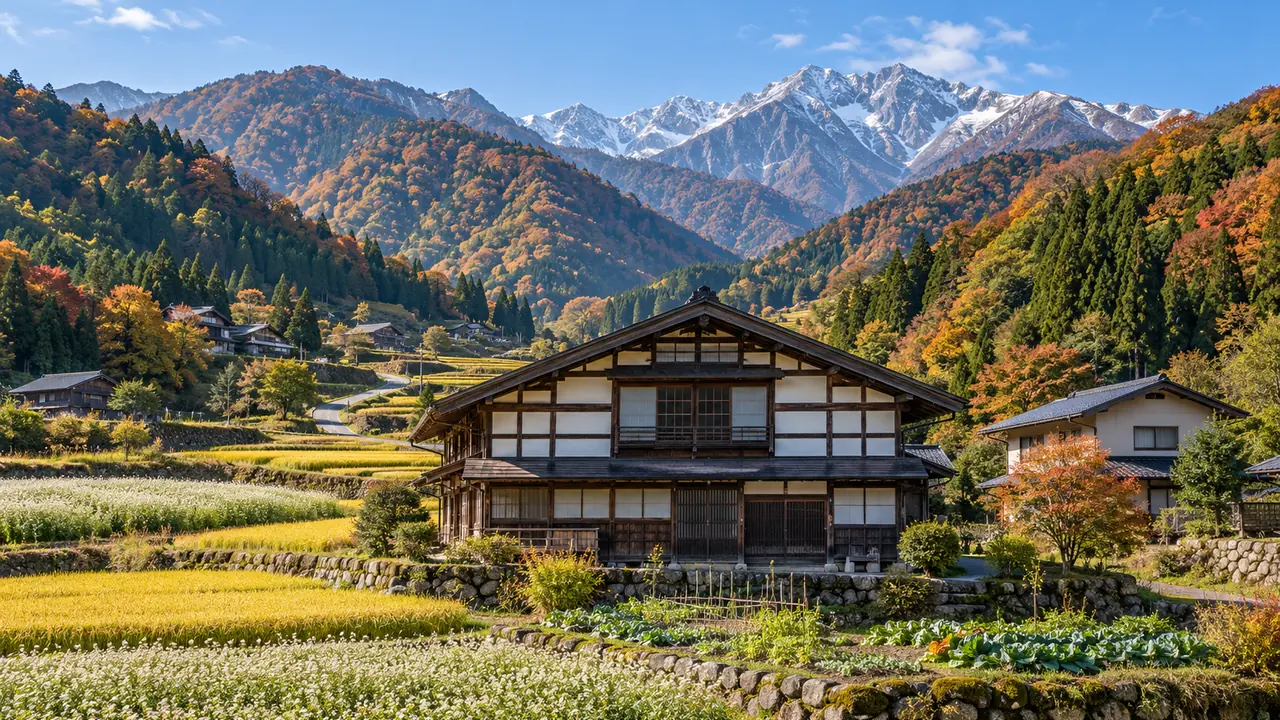
Header image: AI-generated illustration, not a property listing.
Buying a House in Chubu: A Guide to Nine Prefectures and Three Climates
Chubu is not one market. The Sea of Japan coast, from Niigata through Toyama, Ishikawa and Fukui, is heavy snow country. The Alps of Nagano, Gifu and Yamanashi add altitude: Karuizawa's annual mean temperature is 8.6°C, colder than Aomori city's 10.7°C (JMA climate normals, 1991 to 2020). The Pacific side, Shizuoka and Aichi, barely sees snow and instead sits over the Nankai Trough. Each climate changes what a house costs to keep.
On 15 October 2026 our Chubu region page listed 2,702 houses for sale, spread fairly evenly across the nine prefectures. This guide covers each one: the stock and daily life, the main practical risk, and where to see the current houses. For places to visit in each prefecture, start with our overview of Japan's regions.
USD equivalents are approximate, using ¥154 per US$1 for illustration. Yen figures are listed asking prices, not sale prices.
Chubu at a glance
| Prefecture | Houses for sale, 15 Oct 2026 | Median asking price, 6 Oct 2026 | Built 1980 or earlier | Vacancy rate, 2023 | Snowfall at the capital, normal year |
|---|---|---|---|---|---|
| Niigata | 318 | ¥12.99 million | 33% | 15.3% | 139 cm (Niigata) |
| Toyama | 309 | ¥9.8 million | 46% | 14.7% | 253 cm (Toyama) |
| Ishikawa | 288 | ¥21.25 million | 29% | 15.6% | 157 cm (Kanazawa) |
| Fukui | 272 | ¥14.99 million | 32% | 15.6% | 186 cm (Fukui) |
| Yamanashi | 288 | ¥13.8 million | 44% | 20.4% | 23 cm (Kofu) |
| Nagano | 300 | ¥15.99 million | 39% | 20.1% | 163 cm (Nagano) |
| Gifu | 313 | ¥12.99 million | 29% | 16.1% | 34 cm (Gifu) |
| Shizuoka | 321 | ¥18.25 million | 26% | 16.7% | under 1 cm (Shizuoka) |
| Aichi | 293 | ¥29.5 million | 14% | 11.8% | 12 cm (Nagoya) |
House counts are the live inventory on 15 October 2026. Medians and building ages come from our 6 October 2026 snapshot, explained in Japan house prices by prefecture, where the national median was ¥17.99 million (about US$117,000). In MLIT's July 2026 land price survey, average residential land ran from ¥23,100 per m² (about US$150) in Yamanashi to ¥122,700 (about US$797) in Aichi (MLIT). Vacancy rates are from the 2023 Housing and Land Survey; snowfall is the JMA 1991 to 2020 normal at the capital's station.
Niigata: rice country with two kinds of snow
Niigata runs a long way down the Sea of Japan coast and includes Sado Island. Niigata city is the services hub, while the Chuetsu and Joetsu areas inland and to the south hold large farmhouses on big plots. The median asking price was ¥12.99 million (about US$84,000), and 77 of 275 houses in our snapshot were listed under ¥5 million.
Snow varies more than the map suggests. Niigata city's normal annual snowfall is 139 cm; Takada in Joetsu gets 413 cm, with a normal winter maximum depth of 96 cm (JMA, Takada). Every municipality in Niigata is a designated heavy snowfall area, and 18 of its 30 fall wholly or partly in the stricter special category (MLIT). Ask about the roof, the snow-melting pipes (消雪パイプ) that spray groundwater on many streets, and who clears the access.
See the current Niigata houses for sale.
Toyama: the lowest median in Chubu, and the oldest stock
Toyama had the lowest median in the region, ¥9.8 million (about US$64,000), with 79 of 263 houses under ¥5 million. It also had the oldest stock in Chubu: 46% built in 1980 or earlier. Expect large, traditional family houses on the plain between Toyama Bay and the Tateyama range, with Toyama city and Takaoka as the bases.
Those two facts go together. A cheap Toyama house is often an old one under 253 cm of normal annual snowfall in Toyama city (JMA, Toyama), so budget for a seismic check, roof work and heating before you compare it with a newer house elsewhere.
See the current Toyama houses for sale.
Ishikawa: Kanazawa, and the Noto Peninsula after 2024
Kanazawa and the Kaga area offer city services and the Hokuriku Shinkansen, and push Ishikawa's median to ¥21.25 million (about US$138,000), the highest on the Sea of Japan side of Chubu. The Noto Peninsula to the north is rural and was struck on 1 January 2024 by an earthquake that reached seismic intensity 7, the top of JMA's scale (JMA).
For any Noto house, ask for the repair history since 2024, any damage certificate (罹災証明書) and how long local contractors are booked. Kanazawa's snow is moderate, at 157 cm a year.
See the current Ishikawa houses for sale.
Fukui: heavy wet snow and a quiet coast
Fukui had the fewest houses of the nine prefectures in our Chubu inventory. The Fukui plain around Fukui city and Sabae holds most houses, with older towns along the Wakasa coast to the south and the Hokuriku Shinkansen now running through the prefecture. The median asking price was ¥14.99 million (about US$97,000), with 32% built in 1980 or earlier.
Fukui city's normal annual snowfall is 186 cm, with a normal winter maximum depth of 48 cm (JMA, Fukui). Hokuriku snow is heavy and wet, so roof load, gutters and the state of the eaves matter as much as the depth.
See the current Fukui houses for sale.
Yamanashi: the Kofu basin and Mount Fuji's foothills
Yamanashi borders Tokyo to the west. The Kofu basin is hot in summer and nearly snow-free, with 23 cm of normal annual snowfall in Kofu. The Fuji Five Lakes and the Yatsugatake foothills are higher, colder and full of holiday-home estates. The median asking price was ¥13.8 million (about US$90,000), and 44% of houses were built in 1980 or earlier. Its 2023 vacancy rate of 20.4% was the fourth highest in Japan, but much of that is holiday homes, rentals and houses for sale: homes empty for other reasons were 8.7% of the stock.
Two checks matter. Near Mount Fuji, read the Mount Fuji hazard map revised in March 2021 for the exact address. In holiday-home estates (別荘地), ask for the management fees, the private water system and who clears the roads in winter before you look at the house.
See the current Yamanashi houses for sale.
Nagano: altitude decides the running costs
Nagano covers mountain towns, ski resorts and the basins around Nagano city (163 cm of normal annual snowfall) and Matsumoto (76 cm). The median asking price was ¥15.99 million (about US$104,000), and 39% of houses were built in 1980 or earlier.
Altitude is the risk to price in. Karuizawa's annual mean temperature of 8.6°C means long heating seasons and pipes that freeze in empty houses. Slopes are the other check: Nagano had 27,331 designated landslide warning zones in March 2025, the most in Chubu (MLIT). Check whether the lot or its access road is inside one.
See the current Nagano houses for sale.
Gifu: Nagoya suburbs in the south, Hida in the north
Southern Gifu, around Gifu city, Ogaki and Tajimi, works as part of the Nagoya area, with hot summers and 34 cm of normal annual snowfall in Gifu city. Northern Gifu, the Hida region around Takayama, is mountain country with 305 cm (JMA, Takayama). The median asking price was ¥12.99 million (about US$84,000), with 47 of 251 houses under ¥5 million.
Treat them as different searches: in Hida, add winter access, heating and contractor travel to every quote; in the south, check river flooding.
See the current Gifu houses for sale.
Shizuoka: a mild coast over the Nankai Trough
Shizuoka stretches along the Pacific from Hamamatsu through Shizuoka city to the Izu Peninsula and the Fuji area. Snow is almost unknown in Shizuoka city, where the normal is under 1 cm a year. The median asking price was ¥18.25 million (about US$119,000), and Izu adds hot spring resort towns and hillside holiday homes.
The risk is earthquake and tsunami. The Headquarters for Earthquake Research Promotion (HERP) puts the chance of a magnitude 8 to 9 Nankai Trough earthquake within 30 years at 60% to 90% or more under one model and 20% to 50% under another, and asks people to plan around the higher figure (HERP). HERP's 2020 national hazard map gave Shizuoka city hall a 70% chance of shaking of seismic intensity 6 lower or stronger within 30 years (HERP 2020 map), and the Cabinet Office's 2025 estimate puts the highest possible tsunami in the prefecture at 31 m, at Shimoda (Cabinet Office). For a coastal house, walk the tsunami evacuation route, and in Izu ask whether hot spring water comes with a separate supply contract and annual fee.
See the current Shizuoka houses for sale.
Aichi: Nagoya prices and the newest stock
Aichi is the economic centre of Chubu, built around Nagoya and the manufacturing cities of Toyota and Okazaki. It had the highest median in the region, ¥29.5 million (about US$192,000), only 9 of 252 houses under ¥5 million, and the newest stock: 14% built in 1980 or earlier. Nagoya gets 12 cm of normal annual snowfall.
Aichi shares the Nankai Trough exposure with Shizuoka: the same 2020 map gave Nagoya city hall a 46% chance of seismic intensity 6 lower or stronger within 30 years, and parts of western Nagoya and the Ise Bay shore are low-lying land where flooding and storm surge are the checks. Look up the exact address on the GSI hazard map portal before you compare prices.
See the current Aichi houses for sale.
Chubu buyer checklist
- Look up the altitude. Higher houses have longer winters. Above the valley floor, check the heating, insulation and drain-down valves (水抜き).
- Pick your hazard. Hokuriku and Niigata mean heavy wet snow; Shizuoka and Aichi mean earthquake and tsunami. Run the address-level hazard check either way.
- Ask how snow leaves the roof. Get the roof type and last winter's clearing costs.
- Read the estate rules. In holiday-home estates, get the management contract, fees and water terms before an offer.
- Separate hot spring rights. In onsen areas, the hot water supply can be a separate contract with its own fees.
- Ask for repair records in Noto. Request post-2024 repair invoices and a scoped inspection, and confirm contractor availability in writing.
- Check the 1981 line. In Toyama, Yamanashi and Nagano, 39% to 46% of listed houses were built in 1980 or earlier; read what the 1981 standard means.
- Check support early. Grants are municipal and budget-limited. Nagano city's FY2026 grant for movers aged 18 to 59 from outside the prefecture who use its akiya bank covers up to two thirds of renovation, capped at ¥500,000 or ¥1 million (about US$3,200 or US$6,500) by area (Nagano City); Niigata city's closed in August 2026 when its budget ran out (Niigata City).
How we sourced these figures
House counts come from our public inventory on 15 October 2026 and change daily; medians and building ages from our 6 October 2026 snapshot. Climate figures are JMA 1991 to 2020 normals, vacancy rates the Statistics Bureau's 2023 survey, and landslide zones and land prices MLIT data.
Ready to compare real houses? Open the Chubu region page, or search houses for sale across Japan.