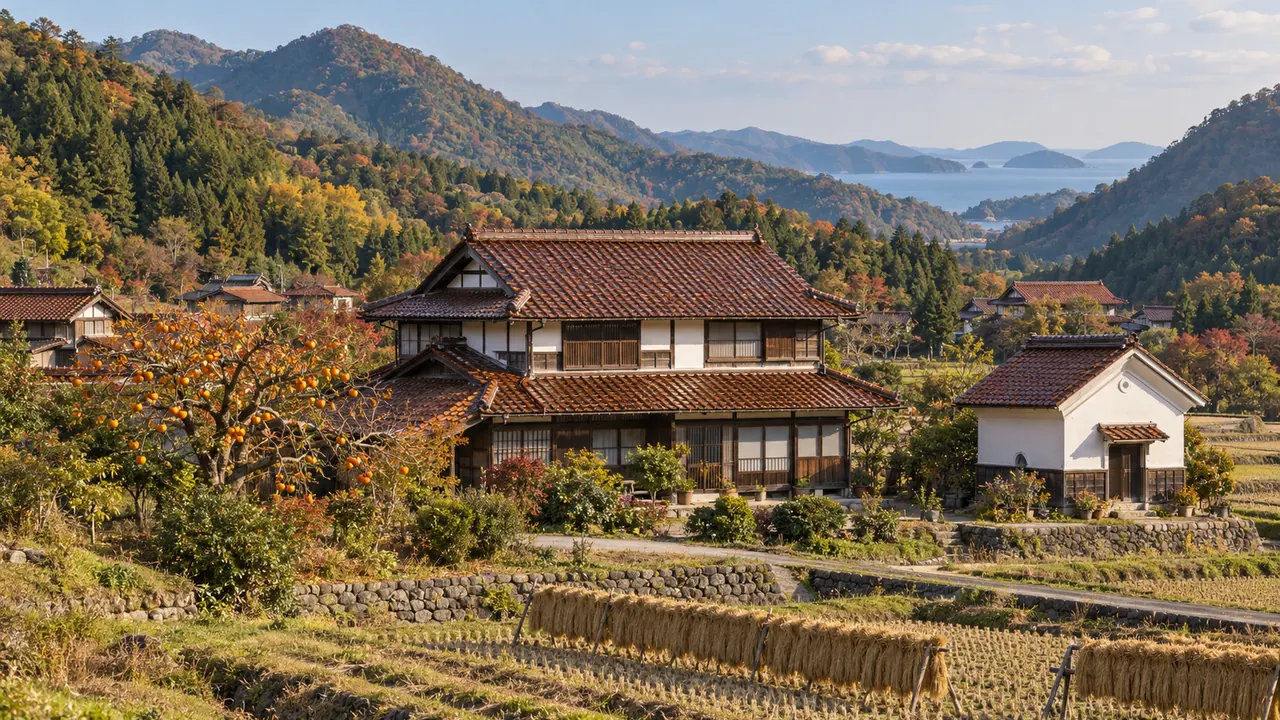
Header image: AI-generated illustration, not a property listing.
Buying a House in Chugoku: A Prefecture-by-Prefecture Guide for Foreign Buyers
Chugoku has two coasts and they behave like two regions. The Inland Sea side (San'yo), with Okayama, Hiroshima and southern Yamaguchi, is mild, dry and well connected by the Sanyo Shinkansen. The Sea of Japan side (San'in), with Tottori, Shimane and northern Yamaguchi, is quieter, snowier in winter, with cheaper land. Between them run low mountains, and those slopes are the region's defining risk: Hiroshima alone had 47,854 designated landslide warning zones in March 2025, more than any other prefecture in Japan (MLIT).
On 15 October 2026 our Chugoku region page listed 2,879 houses for sale, more than any of the other regions covered in this series. This guide takes the five prefectures one at a time: the stock and daily life, the main practical risk, and where to see the current houses. For the places themselves, start with our overview of Japan's regions.
USD equivalents are approximate, using ¥154 per US$1 for illustration. Yen figures are listed asking prices, not sale prices.
Chugoku at a glance
| Prefecture | Houses for sale, 15 Oct 2026 | Median asking price, 6 Oct 2026 | Built 1980 or earlier | Vacancy rate, 2023 | Landslide warning zones, March 2025 |
|---|---|---|---|---|---|
| Tottori | 473 | ¥15.0 million | 28% | 15.7% | 6,232 |
| Shimane | 408 | ¥10.6 million | 55% | 17.0% | 32,213 |
| Okayama | 546 | ¥16.64 million | 36% | 16.5% | 12,753 |
| Hiroshima | 842 | ¥14.99 million | 35% | 15.8% | 47,854 |
| Yamaguchi | 610 | ¥12.0 million | 42% | 19.4% | 25,729 |
House counts are the live inventory on 15 October 2026. Medians and building ages come from our 6 October 2026 snapshot, explained in Japan house prices by prefecture, where the national median was ¥17.99 million (about US$117,000). In MLIT's July 2026 land price survey, average residential land ran from ¥19,000 per m² (about US$123) in Tottori to ¥63,800 (about US$414) in Hiroshima (MLIT). Vacancy rates are from the 2023 Housing and Land Survey. Landslide warning zones (土砂災害警戒区域) are MLIT's count of designated zones per prefecture.
Tottori: dunes, Daisen and a short coastline of towns
Tottori's houses cluster in two places: around Tottori city in the east and around Yonago in the west, which works with Matsue across the prefectural border as one area. Between them, Kurayoshi and the coast towns, and inland, the slopes of Daisen. The median asking price was ¥15.0 million (about US$97,000), with 74 of 521 houses in our snapshot under ¥5 million.
Winter is the check. Tottori city's normal annual snowfall is 140 cm, against 95 cm in Yonago (JMA, Tottori), and the Daisen foothills get far more. All of Tottori is a designated heavy snowfall area, though none of it falls in the stricter special category (MLIT). Ask how the road to the house is cleared, and test the drive to a hospital in winter.
See the current Tottori houses for sale.
Shimane: the oldest housing stock in Japan
Shimane had the oldest stock of any prefecture in our snapshot: 55% of listed houses were built in 1980 or earlier. It also had one of the lowest medians, ¥10.6 million (about US$69,000), with 117 of 462 houses under ¥5 million. The market runs from Matsue and Izumo in the east through the Iwami coast, known for its red-brown glazed roof tiles, to the Oki Islands offshore. In the 2023 survey, 11.3% of all Shimane dwellings stood empty for reasons other than rental, sale or second-home use, the sixth highest share in Japan.
Age and slopes are the risks. Shimane had 32,213 designated landslide warning zones, the third most in Japan after Hiroshima and Nagasaki. Most cheap houses here need a seismic check, roof and plumbing work, and a contractor willing to travel; for the Oki Islands, add ferry freight to every quote. Matsue gets 68 cm of normal annual snowfall.
See the current Shimane houses for sale.
Okayama: the sunny hub with river flood risk
Okayama is the transport hub of the region, where the Sanyo Shinkansen meets the line to Shikoku. Okayama city and Kurashiki offer city services; the north is rural and hilly. The median asking price was ¥16.64 million (about US$108,000), the highest in Chugoku, though 97 of 564 houses were under ¥5 million. Okayama city's climate is dry and mild, with 1,143 mm of normal annual rain and almost no snow (JMA, Okayama).
The risk is water from rivers, not from the sky. Low-lying districts along Okayama's large rivers, including parts of Kurashiki, have flooded in heavy rain in recent years. Earthquakes matter more than the climate suggests: HERP's 2020 national hazard map gave Okayama city hall a 44% chance of shaking of seismic intensity 6 lower or stronger within 30 years, against 24% for Hiroshima's (HERP 2020 map). Check the flood depth layer for the exact address on the GSI hazard map portal, not just the town.
See the current Okayama houses for sale.
Hiroshima: the most houses, and the most landslide zones
Hiroshima had the most houses in our Chugoku inventory (842) and 163 houses under ¥5 million in our snapshot, the second most in Japan after Wakayama. The median asking price was ¥14.99 million (about US$97,000). The choice runs from Hiroshima city and its hillside suburbs to Kure, Onomichi and Fukuyama, the Inland Sea islands, and the snowier hills of the north.
The risk is the hillside. Hiroshima's 47,854 landslide warning zones are the most of any prefecture, and many suburbs climb steep valleys. Check whether the lot is inside a warning zone or a special warning zone (土砂災害特別警戒区域), where rebuilding faces structural requirements. In Onomichi and on the islands, ask whether a car can reach the door, because materials and furniture may have to be carried up steps.
See the current Hiroshima houses for sale.
Yamaguchi: two coasts at the western tip of Honshu
Yamaguchi faces the Inland Sea to the south, with the industrial cities of Shunan, Ube and Iwakuni, and the Sea of Japan to the north, with Hagi and Nagato. Shimonoseki sits at the western tip across the strait from Kyushu. The median asking price was ¥12.0 million (about US$78,000), with 135 of 628 houses under ¥5 million and 42% built in 1980 or earlier.
Older stock on slopes is the check here: Yamaguchi had 25,729 landslide warning zones. Snow is light, at 26 cm of normal annual snowfall in Yamaguchi city and 2 cm in Shimonoseki (JMA, Yamaguchi). For typhoon statistics JMA groups Yamaguchi with northern Kyushu, which averages 3.8 approaches a year against 3.0 for the rest of Chugoku (JMA typhoon normals).
See the current Yamaguchi houses for sale.
The two coasts in numbers
The split between the coasts shows up clearly in JMA's 1991 to 2020 normals for four capitals:
| Normal year | Tottori | Matsue | Okayama | Hiroshima |
|---|---|---|---|---|
| Snowfall | 140 cm | 68 cm | 1 cm | 8 cm |
| Rain | 1,931 mm | 1,792 mm | 1,143 mm | 1,572 mm |
| Mean temperature | 15.2°C | 15.2°C | 15.8°C | 16.5°C |
Sources: JMA normals for Tottori, Matsue, Okayama and Hiroshima.
The Sea of Japan side gets more rain and real snow; the Inland Sea side is drier and almost snow-free. Typhoons approach the Chugoku region 3.0 times in a normal year, a little less often than Shikoku (3.3) and far less than Okinawa (7.7) (JMA typhoon normals). On the San'in side, budget for winter: heating, roof and gutter upkeep and a car fit for snow. On the San'yo side, the money goes on drainage, retaining walls and flood or landslide checks instead.
Chugoku buyer checklist
- Choose the coast first. San'in means snow, winter wind and fewer services; San'yo means more services and milder weather, with heavy-rain floods and landslides as the checks. Do not compare prices across the two as if they were one market.
- Look up the landslide zone for the lot and the road. A house outside a zone can still depend on an access road that runs through one. The address-level hazard check covers how to read both.
- Ask whether a car reaches the door. Hillside houses in Onomichi, Kure and on the islands can need hand-carried materials, which changes every renovation quote.
- Price the age. With 35% to 55% of listed houses built in 1980 or earlier in four of the five prefectures, read what the 1981 standard means and budget for a seismic check.
- Plan island logistics. For Inland Sea islands and the Oki Islands, get the ferry timetable, freight rules for building materials, and a contractor who will travel, before an offer.
- Inspect for the coast you chose. On the San'in side, ask the inspector to check roof tiles, gutters and wall bases after winter; on the Inland Sea side, check drainage, retaining walls and signs of past water entry.
- Check support before you sign. Kure's FY2026 programme gives movers from outside the city ¥500,000 (about US$3,200) toward a used house, rising to as much as ¥1.5 million (about US$9,700) with additions such as one for its island districts, never more than half the price, if they stay five years and apply before the ownership transfer (Kure City). Tottori city covers half of renovation, up to ¥400,000 (about US$2,600), for akiya bank houses (Tottori City), while Onomichi's FY2026 grant had already closed when its budget ran out (Onomichi City). Hiroshima Prefecture runs its own akiya bank, Minto, and our subsidies guide shows how to check a programme.
How we sourced these figures
House counts were read from our public inventory on 15 October 2026 and change daily. Medians and building ages are our 6 October 2026 snapshot. Landslide zone counts are MLIT's table of designated zones as of 31 March 2025. Climate and typhoon figures are Japan Meteorological Agency 1991 to 2020 normals. Vacancy rates come from the Statistics Bureau of Japan's 2023 Housing and Land Survey.
Ready to compare real houses? Open the Chugoku region page, or browse houses under ¥10 million across Japan.