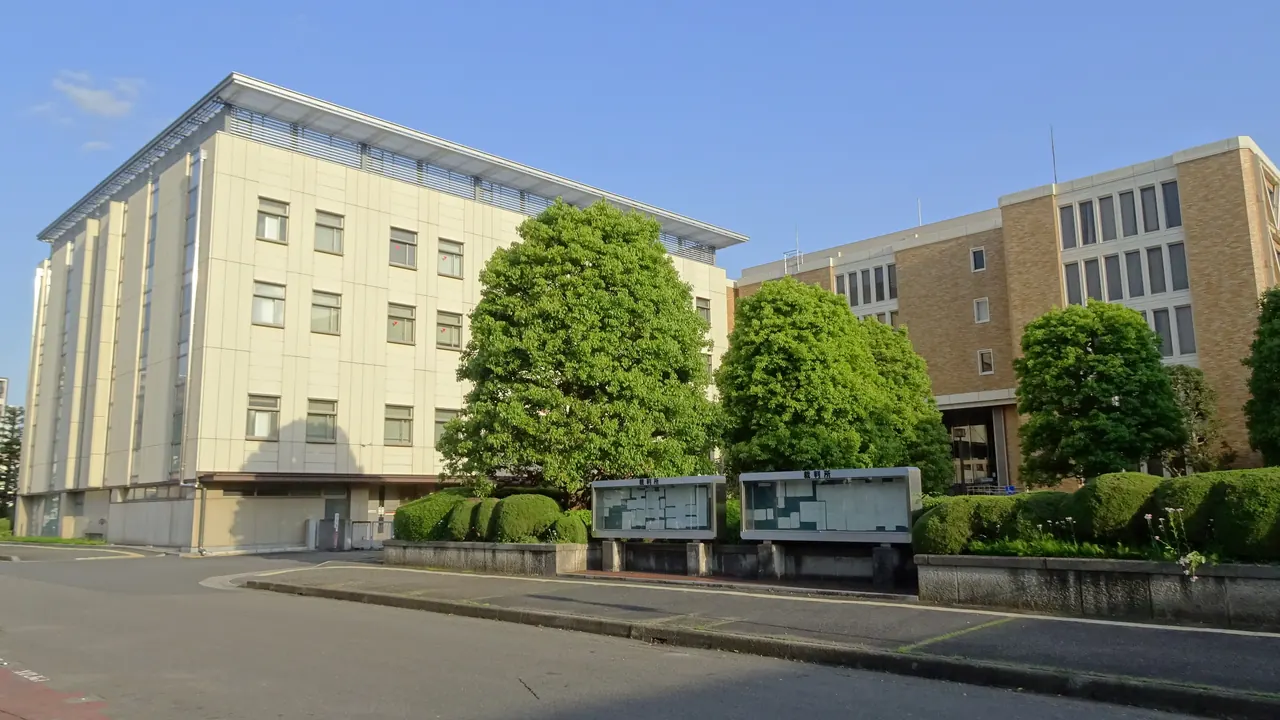
Header image: Saitama District Court in Urawa, Saitama, photographed in May 2025 by Ebiebi2 and released under CC0 on Wikimedia Commons. The boards in front are the court's notice boards.
Buying a House at a Japanese Court Auction (競売): A Guide for Foreign Buyers
Search for cheap houses in Japan and sooner or later you will find a house listed by a court rather than an agent. These are court auctions (競売, keibai): property seized for unpaid debts and sold by a district court to the highest sealed bid. The courts publish them, each with a file of photos and legal findings, on a free website called BIT.
The first question foreign buyers ask is whether they are allowed to bid. In principle, yes. Otsu District Court's bidder guide opens with the rule: "in principle, anyone can bid" (原則として,どなたでも買受けの申出ができます), and the exceptions it lists are the debtor, people barred for rigging, non-payment or gang membership, and buyers who lack a qualification the court has required for that property (Otsu District Court, 2020). Nationality is not among them. The harder questions are practical: documents, cash, timing and whoever is still living in the house.
This guide follows one auction from listing to keys, using the courts' own pages and the Civil Execution Act (民事執行法), all read on 16 October 2026. Buy Houses Japan does not broker, bid or comment on individual auction properties. Where a step needs a professional, we say which one.
USD equivalents are approximate, using ¥154 per US$1 for illustration.
Can a foreigner or non-resident bid?
The Civil Execution Act bars only a few people from bidding: the debtor (Article 68), people who obstructed a sale or failed to pay in it, gang members, and companies with a gang member among their officers (Article 71) (e-Gov, Civil Execution Act). A court can also limit who may bid on a particular property. The common case is farmland, where you need a buyer qualification certificate (買受適格証明書) from the agricultural committee before you bid (BIT glossary).
So the law does not stop a foreign national. The paperwork is where non-residents get stuck:
- Proof of identity in Japanese form. An individual bidder files a resident record (住民票) issued within the last three months, without the My Number, "or a similar document" proving name, address, date of birth and sex (Otsu). Someone with no address in Japan has no 住民票, so ask the court's bailiff office (執行官室) which substitute it accepts, and whether it needs a translation, before you prepare a bid.
- A seal. Tokyo's declaration form guide says the seal need not be a registered one, but without a seal impression the bid is invalid. It also asks for the furigana reading of your name, with name, address, sex and date of birth exactly as on the resident record.
- Money in a Japanese bank. The deposit is wired to the court's account with the court's own transfer slip, and must arrive before bidding closes. Cash and cheques are not accepted (Otsu). The alternative is a payment guarantee from a Japanese bank or insurer.
- Being reachable. Tokyo's Civil Execution Center expects the winning bidder to come in to pay the balance and accepts payment by post only by exception, for example for someone who lives far away (Tokyo District Court).
You can bid through an agent with a power of attorney (代理委任状) (BIT, bidding procedure). After you win, the Ministry of Finance requires a non-resident who acquires Japanese real estate to report it through the Bank of Japan within 20 days of the acquisition (MOF). In an auction you acquire the property on the day you pay (Article 79). Owning a house does not give you a visa; see does buying a house in Japan give you a visa.
How BIT, the courts' auction site, works
BIT (不動産競売物件情報サイト) is run for the Supreme Court and lists auctions from district courts across Japan. It is in Japanese only. You can search by region, area, rail line, court or case number. Each property page has the key facts and a button to download its three documents as a PDF. BIT also shows each court's sale schedule, the results of finished sales and a past-data search by property type, year, area and sale price, which is the best way to see what similar houses actually sold for.
The words you will meet on every listing:
- 売却基準価額 (base price): the court's reference price, set from the appraiser's valuation. By law the appraiser must take into account that the valuation is for a forced sale (Article 58), so it is not meant to be a market price.
- 買受可能価額 (minimum bid): the base price less 20%. A bid below it is invalid (Article 60).
- 買受申出保証額 (deposit): what you pay to make a bid, usually 20% of the base price, and sometimes more. The notice for each property states it.
- 期間入札 (period bidding): sealed bids accepted over a set period, opened together on the opening date (開札期日).
The three documents: 物件明細書, 現況調査報告書, 評価書
The courts call them the "three-document set" (三点セット). They appear on BIT and at the court before bidding opens: BIT says at least a week before, Tokyo usually 15 days, Otsu two weeks.
| Document | Prepared by | What it tells you |
|---|---|---|
| 物件明細書 (property specification) | The court clerk | Whether any lease or other right survives the sale and becomes yours to honour, and whether a building gets a statutory right to stay on land sold separately |
| 現況調査報告書 (status survey report) | The court bailiff | The building's current state, who occupies it and on what claimed right, with photos. The bailiff may enter, open locked doors and question occupants (Article 57) |
| 評価書 (appraisal report) | A court-appointed appraiser | The valuation, the surroundings, zoning and other legal limits, with plans |
Read them in that order. The 物件明細書 sets out the court's view of your legal position. The 現況調査報告書 tells you who is in the house. The 評価書 is where you find planning problems such as a rebuild ban (再建築不可) or urbanization control zone (市街化調整区域), the same red flags our guide to why a house is so cheap explains for ordinary listings.
The courts are blunt about their limits. BIT says the 物件明細書 records only what appears in the file and does not settle anyone's rights, and that the condition of the property can change (BIT, enforcement flow). Tokyo tells bidders to visit the site and check the registry themselves, and to see a lawyer when the rights are complicated.
You usually cannot go inside. The law allows a supervised viewing (内覧) only when the foreclosing creditor applies for it before the sale is ordered, and an occupant with a right that survives the sale can refuse (Article 64-2). Unless your court announces one, you judge the interior from the bailiff's photos. Plan for that if the house was built before 1981: our guide to earthquake standards for old houses explains why that year matters.
Bidding: the deposit, the declaration and the envelope
A bid has four parts, all for one property:
- The bid form (入札書) with the case number, property number and your price. A corrected amount makes the bid invalid; you start a new form.
- The deposit, wired to the court's account so that it has arrived by the last day of the bidding period, with the bank's receipt slip stuck to the court's deposit certificate. Late money makes the bid invalid.
- The anti-gang declaration (暴力団員等に該当しない旨の陳述書). Required with every bid since the amended Civil Execution Act took effect on 1 April 2020 (Ministry of Justice). You declare that you are not a gang member, have not been one for five years, and are not bidding with a gang member's money (Article 65-2). A bid without it is invalid and it cannot be supplied later; it cannot be corrected once filed. If someone else is funding the purchase for their own benefit, you name them on an extra sheet. A bank loan does not count. A false statement can mean up to six months in prison or a ¥500,000 fine (Article 213). The court then asks the prefectural police to check the highest bidder (Article 68-4).
- Attachments: the identity document described above, a company certificate for a corporate bidder, a power of attorney for an agent.
You hand the sealed envelope to the bailiff or mail it so that it arrives within the bidding period. You cannot withdraw or change a bid. On the opening date the bailiff opens the envelopes and names the highest bidder. The next-highest bidder can ask to stand in if the winner fails to pay, provided their bid was at least the minimum bid and at least the winning bid less the deposit (Article 67). Everyone else gets their deposit back; Otsu says the transfer takes about a week.
If nobody bids, the court may move the property to a special sale (特別売却): the first person to offer at least the minimum bid gets it (BIT glossary). Tokyo runs it for three court days after the opening. These are the houses nobody else wanted at that price, so read their files twice.
From the opening to the keys: the court's calendar
We put the timing together from the courts' guides because no single page shows it end to end:
| Step | Usual timing | Source |
|---|---|---|
| Notice posted, three documents on BIT | One to two weeks before bidding opens | BIT, Tokyo, Otsu |
| Bidding period | Set per sale; usually 8 days in Tokyo | Tokyo |
| Sale decision (売却決定期日) | Within about three weeks of the opening | Otsu; BIT's Tokyo example says 20 days |
| Decision becomes final | About a week after the decision date | Otsu |
| Payment deadline | Within one month of the decision becoming final | BIT |
| Ownership and registration | On payment; the court asks the registry to record you as owner | Articles 79 and 82 |
| Handover order application | Within 6 months of payment (9 months for some tenants) | Article 83 |
Put together, expect roughly two months from the opening to ownership, longer if anyone has to be removed. The payment is the full price less your deposit, in one sum. If you miss the deadline the sale lapses and the deposit is not returned (Article 80), and BIT warns that you also lose the right to buy.
Why a mortgage rarely works for an auction house
A loan is legally possible. Article 82(2) lets the buyer and a lender ask the court to hand its registration request to a registration professional they name, in practice a judicial scrivener, who files the lender's mortgage together with your ownership, so the bank is secured on the day it pays. Otsu calls this the "loan method" (ローン方式) and wants the request three court days before you pay.
The calendar is the problem. The deposit, 20% of the base price, must be your own money before you know whether you have won. The lender then has about a month to approve a loan on a house that neither of you has been inside, sold with no seller to stand behind it, and possibly still occupied. For a buyer without Japanese income or permanent residency, our mortgage and tax primer explains why a lender is hard to find even for an ordinary sale. Plan to pay in cash, and treat a loan as a bonus you arranged before bidding.
Occupants and the handover order (引渡命令)
A court auction sells the house as it is, often with someone still in it. The 物件明細書 tells you which kind of occupant you are dealing with:
- No right that holds against you (the former owner, for example): you can ask the court for a handover order (引渡命令), a fast procedure compared with a lawsuit, within six months of paying.
- A tenant who rented before the auction started but after the mortgage: the Civil Code lets them stay up to six months after you buy (Article 395), as long as they pay you the equivalent of rent. Your deadline for the order becomes nine months. If they do not pay a month's equivalent after you demand it, that grace ends (e-Gov, Civil Code).
- A lease that survives the sale: you take over as landlord and cannot remove the tenant with an order.
The order costs little to request: Kochi District Court lists a ¥500 stamp per occupant plus postage, and the order becomes final a week after it is served if nobody appeals (Kochi District Court, 2024). Eviction is the expensive part. You add an execution clause (¥300) and proof of service (¥150 per occupant) and apply to the bailiff, who asks for a deposit that varies by court. The bailiff normally fixes a first visit within two weeks of your application and then gives the occupant about a month's notice before the forced removal (Courts of Japan). Moving and storing what is left inside comes on top.
What you pay after winning
BIT lists the buyer's extras: registration tax and postage for the court's registration request, and, depending on the case, the cost of a handover order, unpaid charges, repair costs an occupant can reclaim, eviction and disposal of left belongings (BIT, sale flow). Two of those are easy to miss. In a condominium, unpaid management fees and repair reserve pass to you, and may have grown since the file was written (BIT glossary). An occupant who spent money on necessary or useful repairs can claim it from you, and one who asserts a lien need not leave until paid (BIT glossary).
The taxes follow the assessed value (固定資産税評価額), not your price, and one differs from an ordinary purchase. The National Tax Agency's table charges 2% registration tax on land bought at auction, with no reduced rate, while land bought by ordinary sale pays 1.5% until March 2029. A house you will live in can qualify for 0.3% instead of 2% until March 2027, if it meets the floor area and other conditions, because that relief covers purchases by sale "and by auction" (競落) (NTA). The prefecture's real estate acquisition tax applies however you acquired the property, at 3% for land and homes until March 2027 (Osaka Prefecture tax Q&A), with residential land taxed on half its value (Osaka Prefecture tax Q&A 1-4).
A worked example, with invented figures for a hypothetical house:
| Item | Amount |
|---|---|
| Base price (売却基準価額) | ¥5,000,000 (about US$32,500) |
| Minimum bid, 80% | ¥4,000,000 |
| Deposit wired before bidding, 20% | ¥1,000,000 |
| Your winning bid | ¥5,600,000 |
| Balance due within about a month | ¥4,600,000 |
| Registration tax, land assessed at ¥2,000,000 (2%) | ¥40,000 |
| Registration tax, house assessed at ¥800,000 (2%, or 0.3% if you qualify) | ¥16,000 or ¥2,400 |
| Acquisition tax, land (half of ¥2,000,000 at 3%) | ¥30,000 |
| Acquisition tax, house (¥800,000 at 3%, before any relief for used homes) | ¥24,000 |
On top of that come the unknowns: eviction, clearance, condominium arrears and the repairs you could not inspect. There is no agent's commission in a court sale unless you hire someone to help you bid. Our guide to the total cost of a cheap house covers repairs and running costs.
Auction, akiya bank or a normal sale?
An auction is one of three ways to buy a cheap house. The other two are a municipal akiya bank, now searchable nationally on two sites supported by MLIT (MLIT; our akiya bank guide), and an ordinary sale through a licensed agent. On 16 October 2026 our own pages listed 7,431 recently verified detached houses at ¥10 million or less, out of 24,804 for sale across Japan.
| Court auction | Akiya bank | Ordinary sale | |
|---|---|---|---|
| Price | Your sealed bid, at least 80% of the base price | Negotiated with the owner | Negotiated from the asking price |
| Seeing inside | Only if the court orders a viewing | Arranged with the owner or town | Normal before you offer |
| What you are told | The three documents, as reference only | Varies by town | A licensed agent must explain the key facts in writing before the contract (Real Estate Brokerage Act, Article 35) |
| Hidden defects | No remedy for the type or quality of the property (Civil Code Article 568) | Set by the contract | Set by the contract |
| Money | 20% before bidding, the rest within about a month | As agreed in the sale contract | As agreed in the sale contract |
| Occupants | Possible; you deal with them | Usually empty | Normally empty at handover |
An auction suits a buyer who has the whole price in cash, a Japanese address or an accepted substitute, a bank account in Japan, and someone who can visit the street and read the file. It also suits a buyer who prefers a forced sale's rules to a negotiation and can price in repairs nobody has inspected. The best candidates have a 物件明細書 with no rights you must take over and a report showing an empty house or an owner-occupier.
It is the wrong route if you need a mortgage, want an inspection before you commit, or cannot handle an eviction. An akiya bank fits buyers who want a town's support and subsidies for people moving in. An ordinary sale fits buyers who want to view, negotiate and get a full written explanation of the property, followed by a step-by-step purchase that can run from overseas.
Who does what
- A licensed real estate agent (宅地建物取引業者) who handles auction purchases can read the three documents with you, check the street and the registry, and file the bid as your agent. Agree the fee in writing first.
- A judicial scrivener (司法書士) is needed for the loan method: Article 82(2) has the court hand the registration to a person entitled to file registrations for others, chosen by you and the lender.
- A lawyer (弁護士) for occupants with disputed rights, an appeal against a handover order, or rights the file leaves unclear. Tokyo's court recommends one when rights are complicated.
- The court's bailiff office (執行官室) answers questions about its own forms and documents. Call the court that handles the property; each runs the procedure slightly differently.
Questions about Japanese court auctions
Can foreigners buy property at a court auction in Japan?
Yes. The Civil Execution Act does not restrict bidders by nationality; it bars the debtor, people who obstructed a sale and gang members. A foreign bidder needs the same documents as anyone else, including an identity document in the form the court accepts, the anti-gang declaration and the 20% deposit.
Can I bid from overseas?
You can mail a bid or use an agent with a power of attorney. The difficult parts are an identity document the court accepts if you have no Japanese resident record, a deposit wired to the court's account in Japan, and being able to pay the balance on the court's timetable. Ask the bailiff office first.
Can I see inside an auction house before bidding?
Usually not. A supervised viewing happens only when the foreclosing creditor applies for one, and some occupants can refuse. Otherwise you rely on the bailiff's photos and description, plus what you can see from the street.
Are court auction houses cheaper?
Bidding can start at 80% of a base price that already reflects a forced sale. But you buy with no inside viewing, no remedy for defects and possibly an occupant, and you pay 2% registration tax on the land. Compare results for similar houses in BIT's past data before you set a price.
What happens if I win and cannot pay?
The sale lapses and you lose the deposit. If the next-highest bidder registered as a stand-in on the opening date, the court can sell to them instead.
Sources and how we checked them
Every figure above was read at its source on 16 October 2026: BIT's procedure pages and glossary; the Tokyo District Court Civil Execution Center's buyer guide and its declaration form guide on BIT; Otsu District Court's bidder guide (April 2020); Kochi District Court's handover order sheet (October 2024); the Courts of Japan page on eviction; the Civil Execution Act, Civil Code and Real Estate Brokerage Act on e-Gov; the Ministry of Justice page on the 2020 amendment; the National Tax Agency's registration tax table (law as of 1 April 2026); Osaka Prefecture's acquisition tax rates; and the Ministry of Finance page on reports by non-residents. Procedures differ by court, so check the notice for your property. House counts come from our public inventory on 16 October 2026 and change daily.
When you would rather view and negotiate, start with houses under ¥10 million, empty houses for sale or all houses for sale in Japan.